AI 4.0FutureCeng / THE FUTURE VISION
Things will change.
The human horizon grows.
We think of a future where AI reduces the routine burden, where people can open up more space for exploration, science, education, and their own ideas.
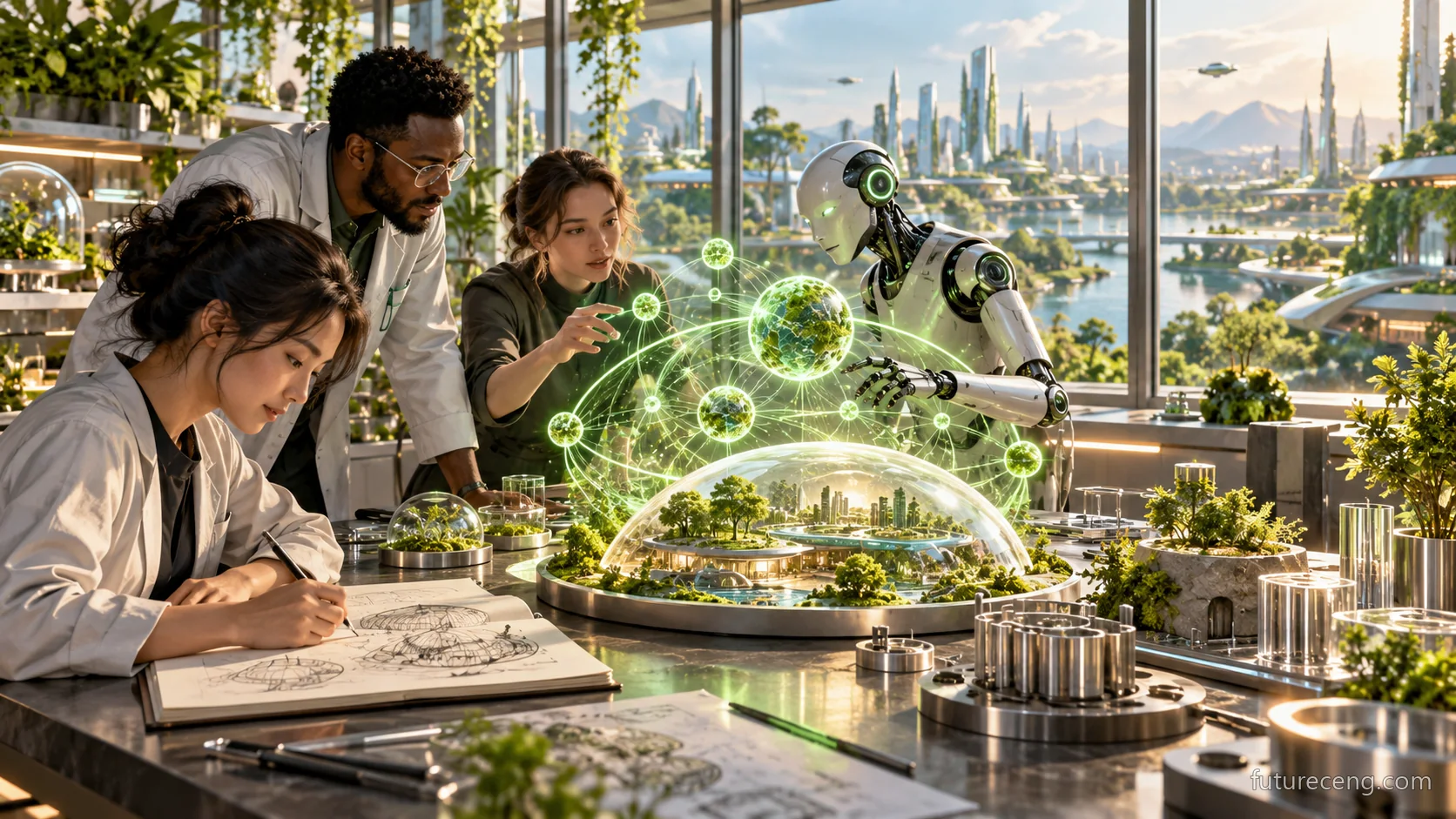
01AN EXPLORATORY LOOK AT MANUFACTURING
From the labour of his hands,
Human + artificial intelligence.
A simplified visual journey that shows the change in production. The final scene describes FutureCeng's goal for the future.
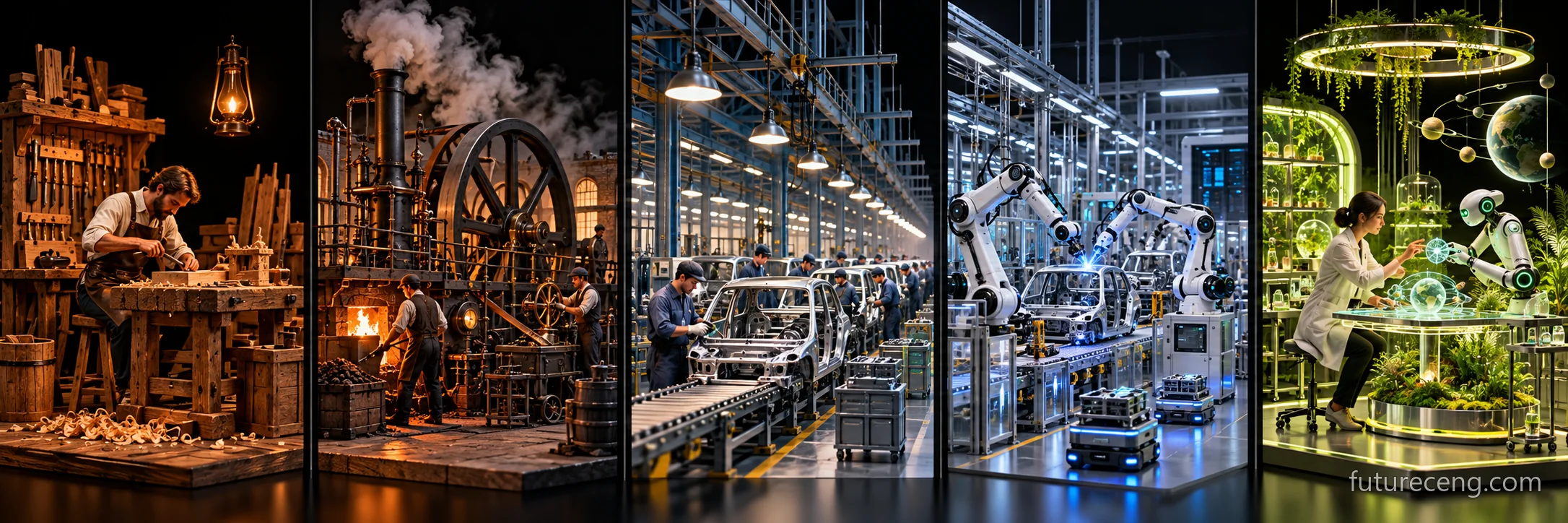
Knowledge is in the hands of man and experience.
It's the opening scene where production is thought of through small-scale workshops, manual labor and knowledge of mastery. This simplifies visual historical change; it doesn't claim that all societies live in the same order at the same time.
Mechanical power is added to muscle strength.
Machinery and steam power change the scale and organization of production. Man's role is not just to do a process; it's also part of the job to install, operate, and maintain the machine.
Electricity and production lines are setting a new order.
Electricity is thought of in conjunction with the division of labor in factories and mass production. The resulting transformation occurs not only in tools but also in the planning of work and the roles of people in the production process.
Physical processes are managed together with data.
Electronic, software, automation and connected systems bring together different layers of production. Here the ideas of digitization and Industry 4.0 are presented together on a broad stage; no detailed date classification is offered.
More space for exploration than the routine burden.
A future where humans, along with AI and robots, are trained by the system, develop new ideas, and contribute to the value that emerges. This scene describes FutureCeng's goal of increasing participation in research and production.
AI 4.0 is the name given to this vision by FutureCeng. Considering the history of manufacturing, you can also look at the human-centred approach of Industry 4.0 and the European Commission's Industry 5.0.
02OUR GOAL & WHAT WE KNOW TODAY
Job titles may change.
People live the transition.
The emergence of new jobs does not mean that everyone in the old job can switch to the new one at the same time.
It's a profession.
A lot of missions.
The ILO notes that because of the work that requires human contributions, the transformation is more likely than not to be completely eliminated. Automating some tasks doesn't mean the whole profession is gone.
New roles,
It's not automatic security.
The WEF's 2025 work forecasts both new and ground-breaking work alongside different economic and technological trends. These are the expectations of employers, not the exact results that can only be linked to artificial intelligence.
More robots,
She doesn't need any less care.
WHO is focusing on investing in education and employment in nursing, closing gaps. Automation of specific clinical tasks alone does not mean that the total need for nurses will decrease.
03TASK → SKILL → ROLE IN 19 PROJECTS
Who can be affected?
What roles can they play?
The future scenarios and roles on this page are suggestions. Detailed career paths and workday stories are on each project's own page.
 SMART MOBILITY
MottoMobil
TASKS AND NEW ROLES
MottoMobil
In MottoMobil, the experience of the service advisor listening to the driver and taking the problem to an expert can turn into evaluating the vehicle assistant's responses. The service operation team can arrange service records and feedback while the road assistance worker checks for lack of demand. For roles such as Vehicle Assistant AI Trainer and Mobility Operations Coordinator, automotive knowledge, data quality, and calm user communication are required together; the first area of learning is to understand why a driver is being misled.
Explore the whole project AUTONOMOUS LOGISTICS
DronFast
TASKS AND NEW ROLES
DronFast
A courier tracking the appropriate delivery routes at DronFast can transport the delivery point and contractual information with the buyer to the drone operation. The drone transmits the Tracking Element to the relevant team by reading the delay on the task screen along with the field conditions; maintenance and training teams can also benefit from these records. The beginning of the transition is not to change all transportation at once, but to examine together the gaps between packet preparation, monitoring and delivery on a defined route.
Explore the whole project THE NEW GENERATION MMORPG
Reacher:Oblivion
TASKS AND NEW ROLES
Reacher:Oblivion
In Reacher:Oblivion, the player's complaint can extend from the community worker's observation to the game designer's experience. Studying the behaviour of competitors who learn in the real world involves jointly assessing the balance of power, the experience of the new player and the in-game narrative. The importance of game economics and content design is also maintained as community knowledge moves to AI behavioral assessment; problems on the same caravan route on a typical workday are the subject of joint review by different teams.
Explore the whole project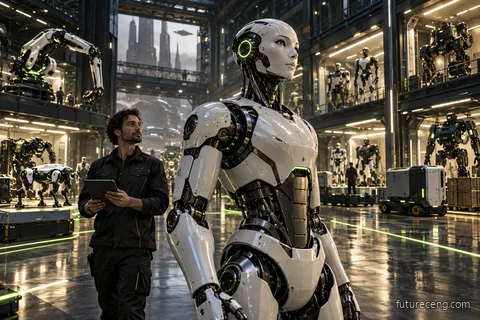 THE ECONOMY OF ROBOTS
OpenJobRobotics
TASKS AND NEW ROLES
OpenJobRobotics
In OpenJobRobotics, knowing where a job is failing can help evaluate the suitability of a robot skill package. When preparing the developer package, business process knowledge, installation and maintenance expertise is part of adapting to the real workplace. The new economic opportunity is not limited to having a robot; it also involves describing the task, examining conformity, and sharing the value of the job in a comprehensive way.
Explore the whole project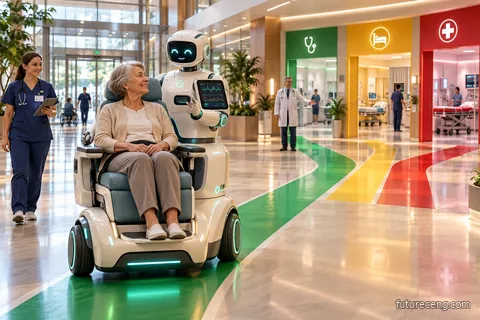 MOBILE CLINICAL ROBOTICS
Nurse Robot
TASKS AND NEW ROLES
Nurse Robot
In the Nurse Robot vision, routine measurement and recording flows change, while nurse monitoring, patient communication, and clinical responsibility take place. Employees who monitor the training and data quality of the robotic-supported flow can contribute to the patient's correct understanding of the problem and the lack of information reaching the relevant team. The sample hospital scenario examines the sequence from the entrance to the doctor's period; the red scenario shows that the transition to the authority team is not delayed until the round is completed.
Explore the whole project WEARABLE HEALTH
Patient Monitoring Suit
TASKS AND NEW ROLES
Patient Monitoring Suit
Understanding the gaps in the tracking record in Patient Monitoring Suit is a broad task of only seeing if a sensor is working. The patient communicator can listen to the user's daily experience while investigating the repeating pattern of the data quality employee. Roles around wearable systems require the ability to relate the maintenance process to device data and explain misunderstandings; clinical evaluation and intervention authority rests with trained healthcare professionals.
Explore the whole project SAFETY OF LIFE IN THE WATER
Safe Healthy Control
TASKS AND NEW ROLES
Safe Healthy Control
In the vicinity of Safe Healthy Control, the lifeguard's field information can be transferred to the evaluation of the flow of emergency reports and calls for assistance. The staff who organize the exercise can see if everyone understands the message of the device in the same way, and the maintenance team can examine the records and the readiness. The new tasks link pool management, user training and technical maintenance; the aim in controlled trials is to develop an understandable support experience under the responsibility of competent teams.
Explore the whole project PERSONAL AVIATION
WingSu FlyCore
TASKS AND NEW ROLES
WingSu FlyCore
Assessing design, simulation, and status messages at WingSu/FlyCore requires different specialties to work together. A person who studies user experience can carry the findings of the technical team to a design decision while investigating why the same icon is interpreted differently. The role transformation here does not directly declare a person a pilot; the research team learns from controlled simulations while aviation training, maintenance skills and authorization are handled through their own processes.
Explore the whole project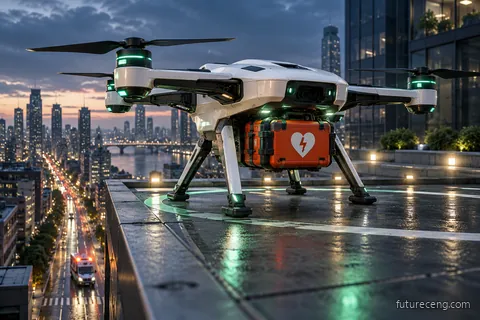 EMERGENCY SUPPORT SYSTEMS
Rapid Ambulance
TASKS AND NEW ROLES
Rapid Ambulance
The recording of equipment delivery in Rapid Ambulance may not mean that all communication on the mission has been completed. People with emergency medical and operational experience can study how access to the right equipment, status transfer, and authoritative team timeline steps are interconnected. The working day example focuses on practice; it explores how logistics and registration work will support this team while remaining in charge of a clinical intervention trained emergency medical team.
Explore the whole project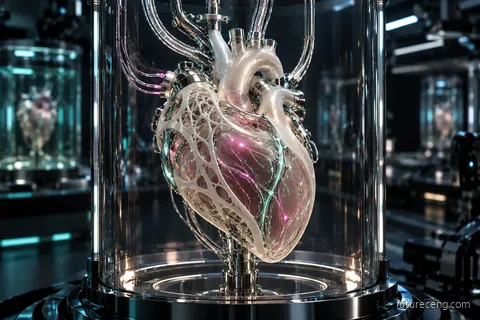 A BIOHYBRID FUTURE
Human × AI
TASKS AND NEW ROLES
Human × AI
Collecting research information in Human + AI, accurately conveying what a publication says, and keeping open questions visible are separate tasks. Employees with experience in science communication or data editing can contribute to the research platform by evaluating automated summaries with relevant experts. A strong-looking headline is rewritten on the day of the sample study; while maintaining clinical decision-making and research authority, the user can better understand the scope of the study and what questions remain open.
Explore the whole project PLANETARY ROBOTS
The Koloni
TASKS AND NEW ROLES
The Koloni
In The Koloni, before sending the robots to another planet, they need to organize the field on Earth, compare records, and coordinate missions. Greenhouse, maintenance, software, and field operations experiences can all come together in a team that explores why robots record the same environment differently. The common skill of these roles extends beyond using a single device: understanding the measurement, evaluating the behavior in the intercept, and constructing the next experiment based on previous findings.
Explore the whole project BRAIN–COMPUTER INTERFACE
Brain Check
TASKS AND NEW ROLES
Brain Check
In Brain Check, it's a question of design whether the interface can correctly understand the user's choice, as well as whether the user can change their choice. Individuals in the fields of accessibility, data analysis, and user research can evaluate uncertainties in communication attempts together with a team of experts. The workday model focuses on making the willingness to give up visible at the interface; while clinical research and implant applications remain within the field of relevant experts, new roles can enhance user experience and data quality.
Explore the whole project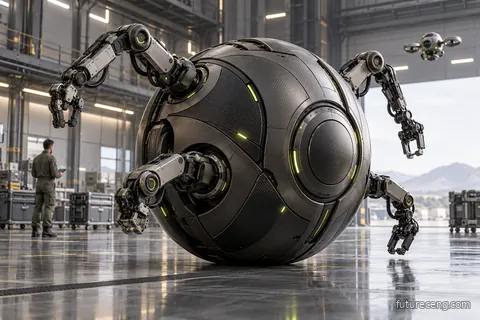 MILITARY TECHNOLOGIES
Ateş Topu
TASKS AND NEW ROLES
Ateş Topu
Career recommendations around Ateş Topu are related to training, understanding equipment status, maintenance records, and human supervision. A VR instructor at a training center can improve the training content by investigating why the same status statement is interpreted differently. This link between technical support and the training team aims to help employees use a common language; detailed roles paths and the training day story are included together on the project page.
Explore the whole project TINY CAPSULE / FOOD EXTRACT
Every Day 3 Gre-eat
TASKS AND NEW ROLES
Every Day 3 Gre-eat
A small capsule idea in Every Day 3 Gre-eat brings food research, quality reviews, and product descriptions to the same table. Individuals with research and content experience can adjust what information their nutritional claims are based on besides the selectable aroma design. The new roles focus more on clarifying the research question than on the appearance of the product, understanding the measurement records and communicating expert assessment to the user openly; nutrition and health decisions are handled with the necessary expertise.
Explore the whole project VERTICAL CAPSULE LIFE
Capsule AI Home
TASKS AND NEW ROLES
Capsule AI Home
In Capsule AI Home many small living spaces require coordination of shared laundry, kitchen, and service flows. The facility employee can move into a new role that improves the ability to know when what demand is concentrated, task ranking, and user information. The opportunity surrounding automation is not just about device maintenance; it's also important to see the shared service capacity, solve a conflicting demand, and understand how different user needs are met in the same building.
Explore the whole project THE TOUCH OF VIRTUAL UNIVERSES
VR AI Simulations
TASKS AND NEW ROLES
VR AI Simulations
The transition of a user from a virtual home to another work space in VR AI Simulations requires that the expectations of the two environments be considered together. Digital content, community support and experience design staff can explore how the portal is understood, what the user carries alongside, and where they need support. The roles that develop personal digital worlds combine content production with permissions and understandable user control; the example workday looks at both sides of this transition.
Explore the whole project WEARABLE AIRCRAFT
Fly Human
TASKS AND NEW ROLES
Fly Human
Investigating the meaning of the request for support in Fly Human requires first accurately describing the situations in the simulation. Employees in the fields of technical recording, experience design and training can compare how the user and the authoritative team perceive the same phenomenon by studying together a report related to decreased energy. The proposed roles are built around controlled research and evaluation; flight suitability, maintenance and implementation responsibilities are handled with the necessary aviation competence.
Explore the whole project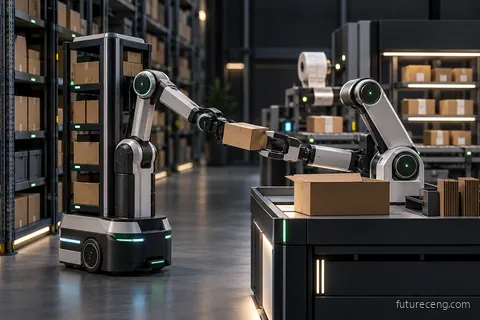 FROM ORDER TO RETURN
Ecommerce AI Bot
TASKS AND NEW ROLES
Ecommerce AI Bot
Knowledge of product, packaging and return details by the warehouse worker in Ecommerce AI Bot can be used to evaluate the exceptions to the robotic line. As the order moves from shelf to packaging, the return of another product may require quality inspection and stock matching; process design looks at the connection between these two flows. The new roles surrounding the advancing software within DetayEntegre and DetayMarket also require understanding which operating team an uncertain product will be directed to as much as reading the auto record.
Explore the whole project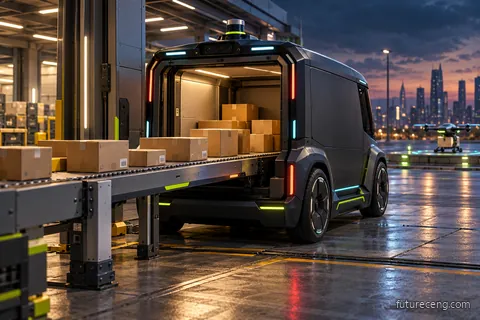 GROUND + AIR LOGISTICS
Cargo Robot
TASKS AND NEW ROLES
Cargo Robot
In Cargo Robot and Kargo Car AI, shipment planning, point of delivery experience and maintenance records may meet in different new missions. The volume, contents, route and actual capacity are also taken into account when allocating 10 kg and above on the proposed network to the overland line, while lighter packages are allocated to the DronFast assessment if appropriate. The working day focuses on the steering of a full-border packet; the basic skill for an operations supervisor is to read the defined network decision and exception accurately rather than assuming a general flight rule.
Explore the whole projectCENK’S VISION / A FUTURE CREATED TOGETHER
A man's worth is not measured by the repetition of what he does.
Automation of a task does not mean that the person who has done it so far has become worthless. Knowledge, attention, care, and understanding the need for others are the invisible aspects of many things. Instead of leaving people behind with the "old profession" label, we want to think about how this accumulation will move into new systems.
The goal of FutureCeng is a world where people can devote more time to learning, exploring, science, and developing their own ideas. Not everyone needs to want the same job or be entrepreneurial in the same way. More options and a better work experience are at the heart of this vision.
The title may change. The transition doesn't happen on its own.
A courier can choose to be a drone tracker; a healthcare worker can take on new responsibilities in a robotic-supported workflow. But this transition isn't just about writing a new title. It requires training, accessible tools, practical experience, suitable working conditions and real job demand. Some positions may be shortened as some assignments change; the same person may not be able to immediately transfer to a new job.
So the career matches here aren't projected job numbers, they're thought-provoking role suggestions. Especially in healthcare, the fact that a robot can perform a specific task does not mean that it takes full responsibility for clinical decision-making, patient communication and care, or that it reduces the total need for a nurse.
It comes from artificial intelligence: a goal of opportunity open to everyone.
Today, we imagine an economy where a person who develops a tool or a task package can generate income from that production in the future. Robot owners can provide services, developers can develop skill packages, experts can evaluate models. OpenJobRobotics is one of the clearest responses to this idea in any project.
For this economy to function, it needs to find customers, produce a valuable service, cover costs, and design a fair share of profits. Our vision is not to make entrepreneurship compulsory, but to open up more ways to participate in production.
Things going on since the founder and the agents.
We think of a future where all the knowledge of a business is not just in the mind of its founder. Defined processes and boundaries, AI agents can make it easier for people taking over to access information, follow routine tasks, and manage continuity. It's a business vision to be addressed within human authority and responsibility.
We cannot assume that a system will continue indefinitely on its own after the founder's death. Authority, data and asset management, accountability and human control should also be regulated. "Artificial supernova" is a long-term assumption in this description; it's not a proven FutureCeng product that works today or a promise of immortal operation.
A healthier life, a broader curiosity.
The appeal of the new world model is not just the acceleration of production. More affordable care, less preventable health care, and more participation in people's lives are part of that goal. We're exploring what burdens technology can reduce on maintenance and everyday life.
A future that man and AI explore together doesn't have to be a closed space for scientists. The process of improving by a maintenance professional, a new tool by a developer, or a good question asked by a user can also be part of the progress. For us, AI 4.0 means that participation is growing.
Let's read a change in a job, within a task.
A job title doesn't tell us all the details. The same courier delivers, tries to understand the address, talks to the client, and finds a solution in an unexpected situation. The same service consultant keeps records, listens to the driver, agrees with the technical team, and investigates why a request has not been resolved. Some of these tasks can be simplified with software, while others can be more visible. When we read the AI 4.0 map, we want to ask first which repetitive work is decreasing, and then which decision still needs a human. So we don't just read the change from the specifications of a new device.
This view brings the existing employee's experience to the design stage. It's important that the person using the system is able to tell you what problem that screen needs to solve instead of just looking at the last screen. A misdirected request, an unavailable delivery point, or an incomprehensible status message can provide a tangible start to technical improvement. The days of work on the project pages focus on these very small encounters: a team detects a flaw, talks to the people involved, and determines what will change in the next experiment.
Let's not hide learning behind a new title.
Giving a worker a new role name doesn't complete the learning process. The person watching the drone network needs to be able to read the mission screen, understand what the records say, and know the limits of their authority. The robotic workshop team needs knowledge to be able to communicate maintenance, task compliance and unexpected situations to an expert. These skills make sense when combined with experience from a previous job. When thinking about the learning process, who will educate, how to allocate time for practice, and where questions will be asked, it should also be part of product design.
So it's helpful to think about the transition over a small task. First, the current flow is understood, then a new tool is used in a test environment, and it describes what works easier or harder. A detail that the technical team doesn't see can instantly become apparent to the person doing the same job every day. User support, an accessible narrative and feedback channel also allows for continued learning. The goal here is not for everyone to go to the same expertise, but for different people to multiply the ways they can participate in the new system using their own knowledge.
It's time to make a profit on a person's day.
The question at the heart of AI 4.0 isn't limited to how many seconds a transaction takes to complete. We want to see what time people can take when the repetition is reduced. It may be worthwhile for a healthcare worker to listen to the patient, to investigate an unresolved demand for the service team, to try a new idea for a developer. In the area of shared living, more understandable management of daily activities can increase the amount of space a person has in his or her own life. The ability of employees and users to speak up about how to use time is the human-centered aspect of this vision.
A good experience doesn't build up the complexity of the background on the user. A person must be able to understand where to start, at what stage of the process, and who to reach when help is needed. It's also the system's job to explain the status of the robot or the software. In this way, writing interface text, evaluating a notification, or setting up a support process is not a small detail. The connection between technology and people is what makes these things work, and most of the new roles in the project stories come from these very connecting points.
Let's talk about the contribution to the robotics economy.
One of the questions raised by OpenJobRobotics is how to combine the different contributions that make a job possible. The robot owner provides the equipment, prepares the developer skill package, describes the business needs, and evaluates the expert environment in the field. When a task is completed, it is necessary to understand which of these contributions assumes what responsibility. Talking about the scope of the service, the need for maintenance, and how to see the work done is just a broader design issue than a pay screen. In AI 4.0, we think about the idea of income together with these relationships; we want to have different forms of participation in production.
One person may want to develop his own product, while another may prefer to maintain his expertise in a regular team. One business can offer a new service, another business can focus on solving a small problem in the flow. Rather than narrowing these options down to the same measure of success, it's more helpful to look at who meets what needs. On the first try, you can see what the customer finds valuable, what the employees do, and how the maintenance burden is shared. The big idea about the future of the economy becomes debatable through these tangible relationships.
Choosing my next step together.
The map on this page is the beginning of a reading. When you're interested in a project, you can proceed with the current status, resources, and the proposed first experiment on your page. You can see where the broad vision is reduced to the little questions and what specialties can work together. It is also worth noting that the same technology meets different needs in different projects. Understanding a status report correctly leads to other responsibilities in flight simulation, other responsibilities at the warehouse, and other responsibilities for patient tracking. Talking about these details allows us to think about the future not just through images, but through real people's actions.
What Cenk has in common with these projects is that people can find more space for their curiosity and willingness to produce. Not all ideas need to be completed at the same time. Clarifying a research question, making a prototype understandable, or reflecting an employee's experience in design is also part of progress. The future diary will reveal the human side of these questions, and the project pages will reveal details of individual systems. AI 4.0 connects them: identify the task, share experience, have an appetite for learning, and think about how to share the resulting value among people.
"Our goal is not to take people out of business.
To open up more space into your dream".— FutureCeng / AI 4.0 VISION
What do we think of this transition?
Instead of erasing a profession, look at what's changed.
Find the replacement of the existing experiment in the new system.
Create education, time, access and real job opportunities.
Make the relationship between profit, power and responsibility visible.
Resources and limits of concept
You can read the employment assessments and the human-centered approach to production along with the research below.