FC—13MILITARY TECHNOLOGIES
Ateş Topu
A spherical robot. A human decision-maker.
MILITARY TECHNOLOGY / HUMAN–MACHINE INTERACTION
A new form of vehicle. Human judgement at the centre.
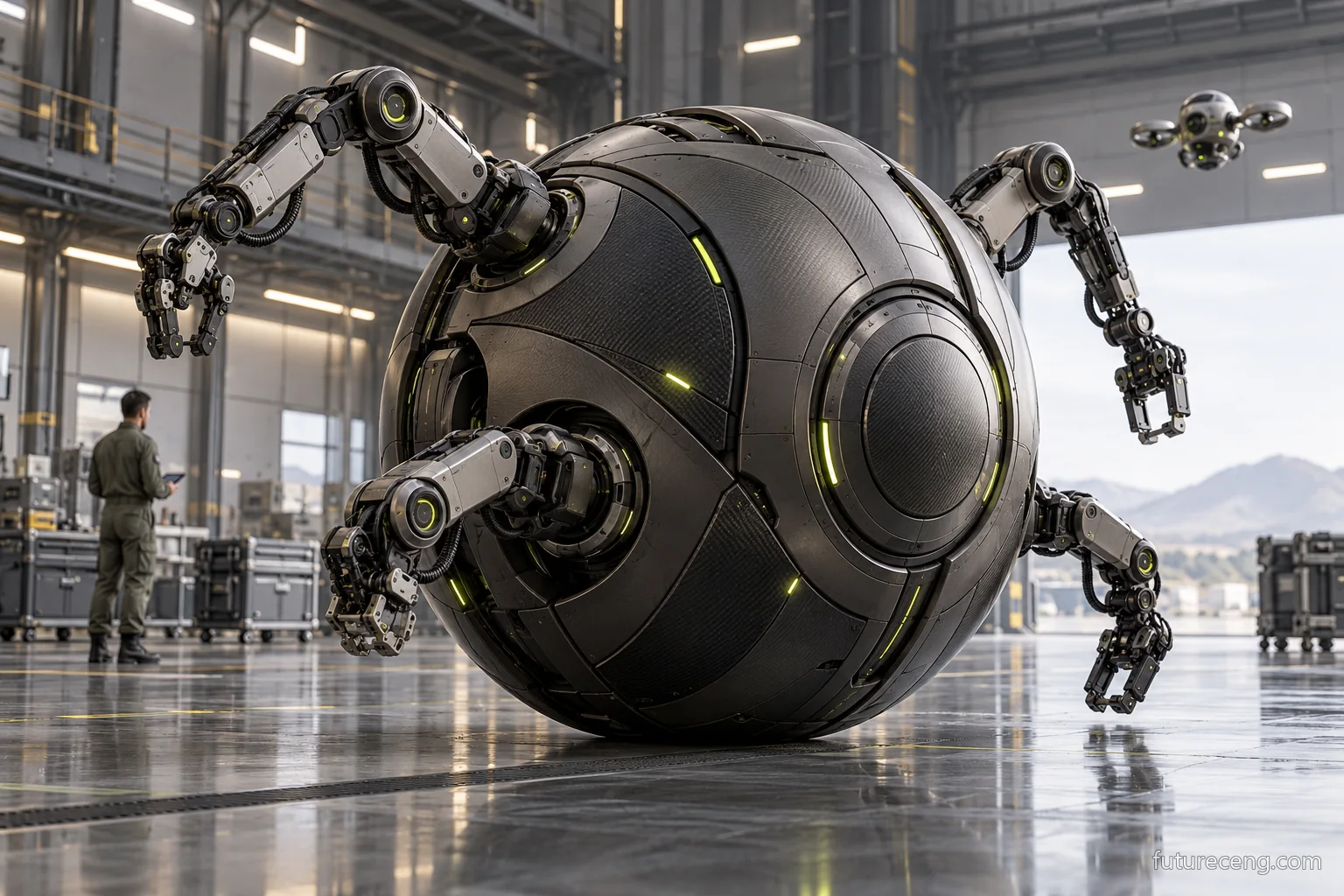
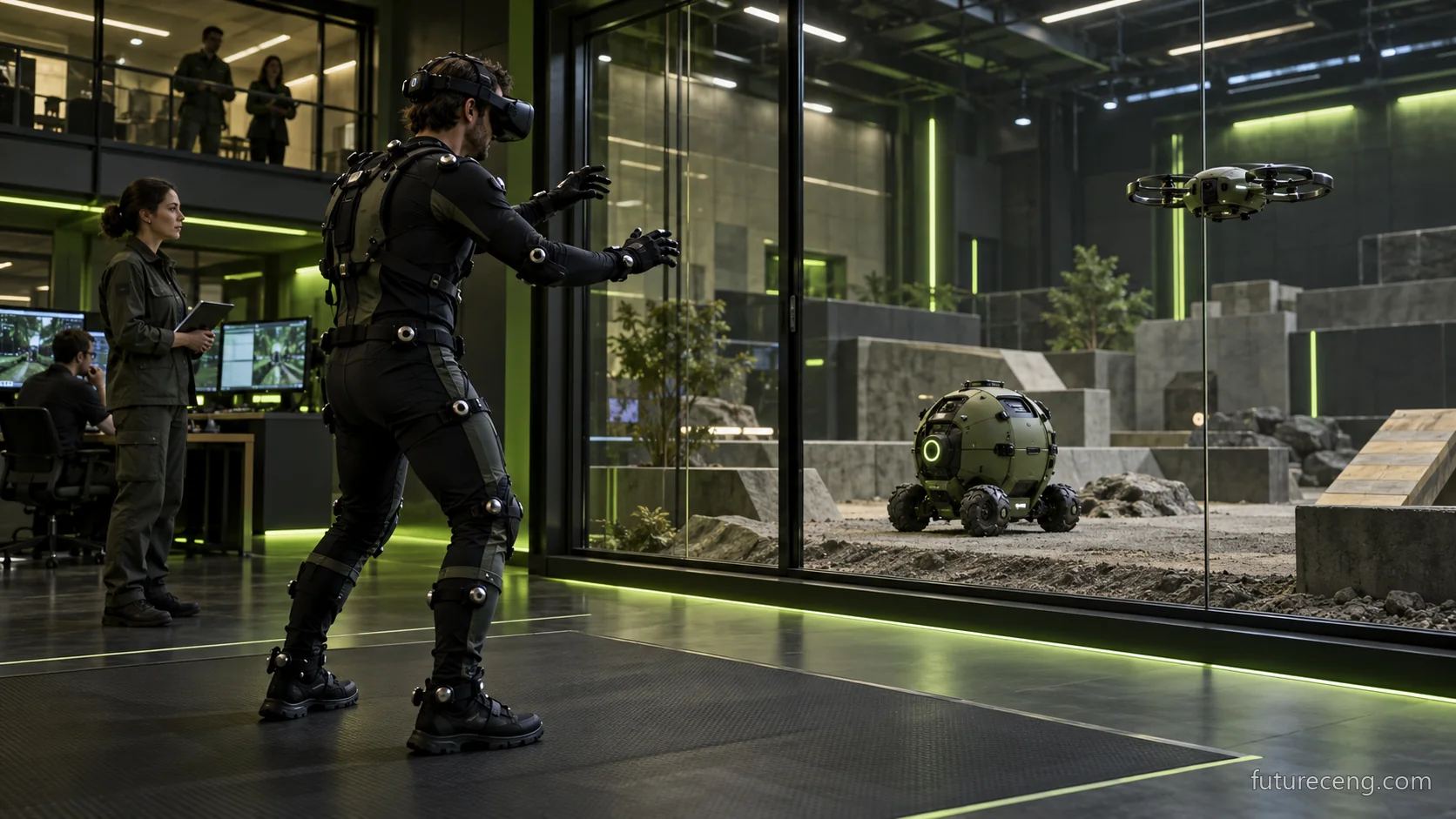
An operator wears a VR suit in a protected location. At a distance, a spherical robot responds to their movements, deploys its arms and relays what it observes.
The Ateş Topu's starting point differs from a conventional vehicle silhouette: a rounded sphere, multiple arms that open when needed, and a VR costume that transmits operator movements to the vehicle. The enclosed spherical body eliminates the problem of the vehicle's collapse and preserves the delicate parts inside.
There's a human being at the center of your mind. The robot enters the field, and the operator stays out of the risk zone. Thanks to the VR costume, the vehicle is controlled not by a screen and joystick, but by the operator's own body, and the robot's cameras and sensors transmit to the operator what it sees and feels. The drones are looking from above, working on the orb-robot floor.
It's a concept today. We're faced with tough engineering questions like energy, communication and resilience, and visuals are not a production plan. But the question is clear: How do you design a system that makes decisions in humans while leaving the hazard in the field to the machine?
As machines become more capable, how can the human role remain clear?
The real challenge with military robots is often not the vehicle itself, but how fast and accurately the operator understands the situation. So Ateş Topu thinks of the tool and the interface together: what does the operator see, what decisions does he make, what kind of work can the machine do on its own? The clearness of these limits is a prerequisite for the efficient and responsible use of such a system.
THINK OF IT AS A SYSTEM.
Four parts.
One connected experience.
The orbital body
The closed body, which moves by rolling, aims to advance and protect the internal hardware from rolling over on the obstructive floor. Arms are only open when necessary.
The costumes of VR
The operator controls the vehicle with body movements. The costume is thought to be an interface that transmits what the robot sees and touches back to the operator.
Drone layer
The drones monitor the field from above, and the sphere transports areas that the robot cannot see to the operator's screen.
Human control
Critical decisions are always in the operator's hands. The machine can move and collect data; humans can decide what to do.
 CONCEPT IMAGE
THINK ABOUT THE FUTURE DIFFERENTLY.The machine's in the field, the decision's in man.
POSSIBLE EVERYDAY SCENARIOS
Technology matters
when it touches lives.
Let’s look at the intended experience through everyday life.
A robot enters a dangerous area first.
A unit wants to know a structure before entering it. The spherical robot is rolled in, its arms open, and it has no doors and no obstacles; the operator manages them all from a safe point with a VR costume.
A heavy burden cannot be carried by man
It's difficult and exhausting to carry equipment on barren ground. Multi-armed balloon robot loads, drones track the route from above, the unit only confirms the route.
Training starts with simulation, not fieldwork.
Operators are trained in a virtual field in the same VR costume before working with a real tool. So knowing the vehicle's reactions doesn't put anyone at risk.
How to change your name / Ateş Topu
Today's experience,
What's tomorrow's business?
What tasks can the experience in this work accomplish with new tools?
Thinking about education, care and human monitoring around Ateş Topu.
Education, care, human monitoring and logistics can be reshaped around a remote-controlled platform such as Ateş Topu. It can be more automated to manually format training session reports, write the same device status to different files, and update the routine inventory. In turn, it takes human skill to monitor how employees understand a simulation, to keep responsibilities open, and to pass maintenance information on to the right person. The storytelling skills of the enterprise training specialist, the technician's registration discipline and the warehouse employee's organizing experience can be evaluated in new support roles. These tasks focus more on how people interact with the system than on the technical presentation of the concept.
The operator observes how employees understand the interface, accountability statements, and support processes in training. He records unidentified statements and improves training materials with the team. Teaching, understandable sampling and feedback gathering skills are combined with training to recognize VR tools; the goal is for the employee to understand the information, stop when necessary, and seek support from the appropriate expert.
It tracks the maintenance history, service requests and non-use status records of devices under its jurisdiction. It asks the expert for the missing information and allows teams to look at the same case record. Technical documentation and regular work tracking habits can be adapted to new equipment; the next team is aimed at being able to see past records, pending tasks and the specialist to be applied to in a clear way.
It tracks records, deliveries, and deficiencies of training equipment and general maintenance supplies. It communicates with relevant individuals to prevent the same information from conflicting in different files. It expands stock ordering and delivery recording experience with new digital tools; focusing on ensuring continuity of daily work training and maintenance support, up-to-date records, and allowing teams to find the information they need.
Where's the new business idea? The services that can be investigated may be limited to VR operator training, maintenance documentation, human surveillance records and general equipment tracking. The first need discovery can focus on showing which notification employees misunderstand or which maintenance information they fail to find. Value in these areas can come from solving an open-ended support problem and ensuring that responsibilities remain understandable among teams.
- Manually editing training simulation records
- Compile routine maintenance reports
- Repeatedly update the field inventory
- VR simulation instructor
- The robot maintenance technician
- Responsible for Human Oversight
- Field logistics coordinator
- Assessment of the simulation experience
- Simulation and human factors
- Maintenance documentation and quality control
- Human oversight and responsibility record
Education, care and human supervision require relevant skills.
Read this transition and other projects in AI 4.0EVIDENCE ALONGSIDE THE VISION
Around the world today
how far have we come?
The collaboration between humans and unmanned systems was also discussed in DARPA's completed Squad X research program. This example does not show that Ateş Topu works or carries the same characteristics. The ICRC stresses the importance of human control and accountability in autonomous systems.
The difference is in the shape and control model of the vehicle: a closed sphere instead of a wheel or pallet, a VR costume that performs the operator's bodily movements instead of a joystick. Energy, communications and resilience are engineering questions that have yet to be solved.
PRIMARY SOURCES · LAST CHECKED 26 OCTOBER 2026
A BIG VISION. A MEASURABLE FIRST STEP.
What could we
try first?
The first step is a small-scale spherical prototype and a simulation that manages it in a VR suit: how quickly does the operator understand what the vehicle sees, how naturally its movements are transmitted? There's no point in designing a big platform without answering these two questions.
A FEW MORE GOOD QUESTIONS
Questions worth asking.
Is Ateş Topu available today?
No, I'm not. Ateş Topu is a concept; there is no working prototype or field tool. The first step is a small prototype and simulation.
Does the robot make its own decisions?
No, I'm not. The basic principle of design is that decision rests with man. The robot moves, sees and collects data; the operator decides what to do.
Why the shape of the sphere?
An enclosed sphere cannot be rolled, it can be rolled in any direction, and it protects the internal hardware. Since the arms are only opened when necessary, they remain compact when moving and moving the vehicle.