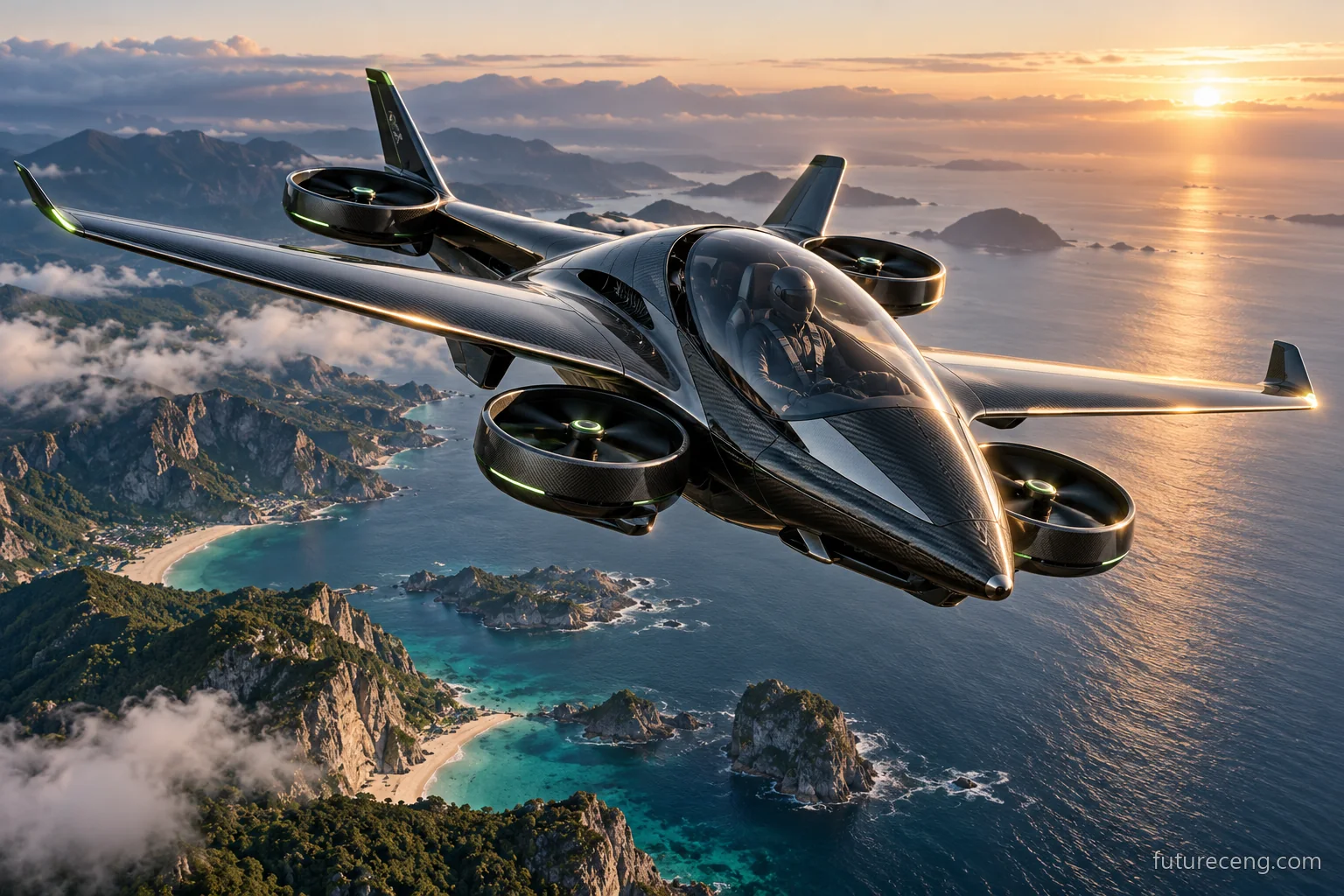
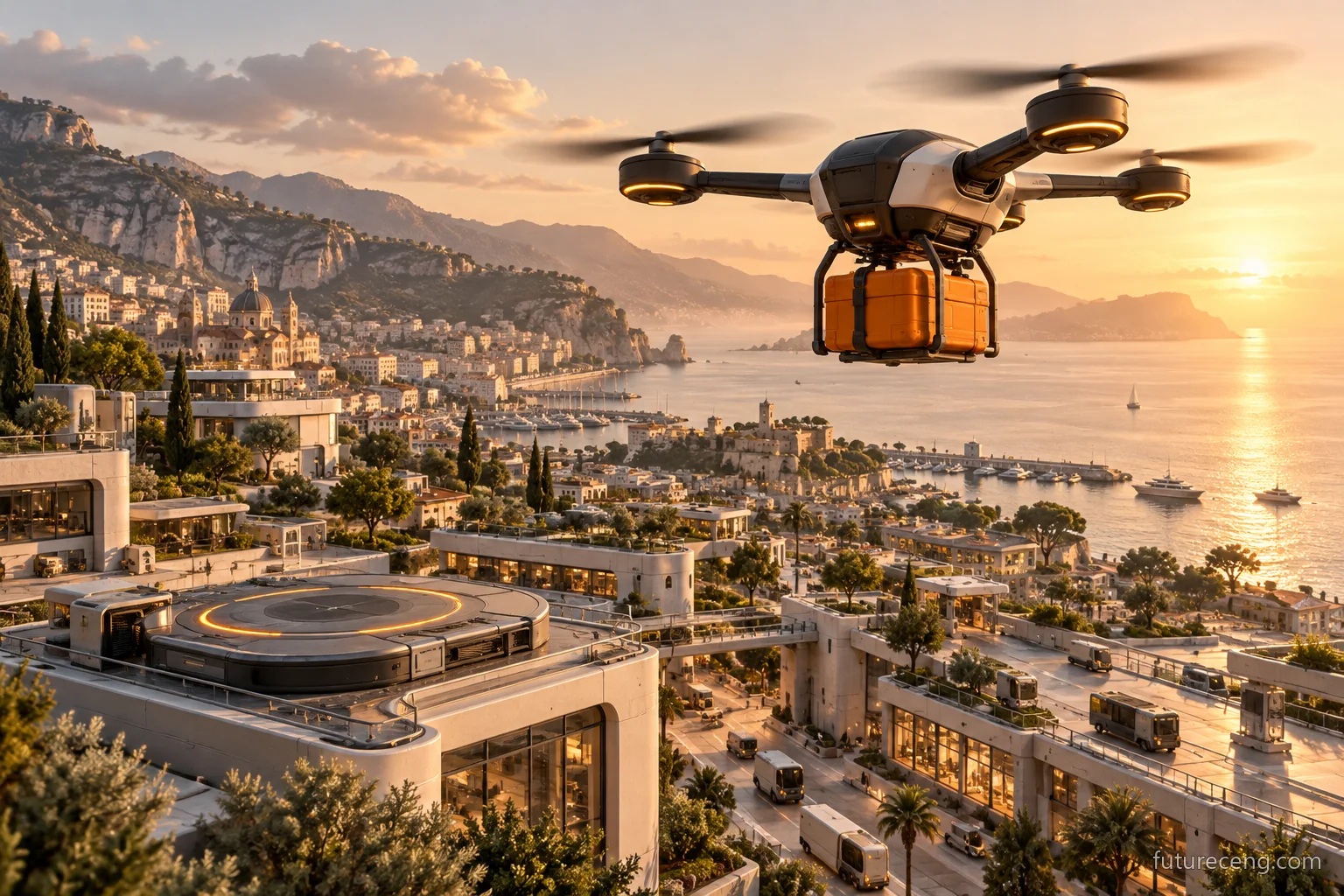
FC—17WEARABLE AIRCRAFT
Fly Human
Flight as a vehicle. Worn as a suit.

PLANNED FLIGHT WITH WINGED COSTUME / SUPPORT NETWORK
What support system would a wearable future of flight need?
You wear a flight system instead of sitting inside an aircraft. Wings deploy and compact propulsion units engage. Behind the experience sits a network monitoring energy status and potential support needs.
The starting point of the Fly Human is a suit: a personal flight system designed to be attached to the human body with retractable wings and compact jet loss. In addition to WingSu FlyCore's vehicle approach, there's the fantasy of turning flight into a near-body experience. The moment the wings are opened, looking at the sky from a different angle and feeling the movement directly forms the emotional center of the project. The visuals mirror this future design, where speed and range data have not yet been determined.
The second part of the vision is a support network that doesn't leave this suit alone. When the energy or fuel level drops, the system can communicate with the nearest suitable support station; in the future, a support vehicle is requested to join and provide reinforcement. The idea of a service reaching the user allows you to think of a new infrastructure around personal flight. Combined air supply is not yet a confirmed feature; the capacity of the communication, physical transmission and support vehicle should be investigated separately.
The important distinction is not to think about the need for support when the energy is completely depleted. The longer flight target must be addressed in conjunction with the reserve, return, landing and support vehicle's own capacity. Coming close in the air to a small system on the human surface is a different problem than the supply between big planes. Approximation, weather, human factors and error situations are part of simulation and professional research. The first study may aim to understand these relationships before they actually fly.
Does longer flight depend only on more energy, or on a better support system?
The idea of a wearable flight should also include maintenance, training, simulation and ground services. It determines when the request for support arises, to whom it reaches and whether an appropriate service point is available. Fly Human can therefore be thought of not just as a costume silhouette; it can be thought of as a field of research that combines human, weather and logistics.
THINK OF IT AS A SYSTEM.
Four parts.
One connected experience.
Wearable mode of flight
Costumes, retractable wings and compact jet units are all conceived in the same design. Physical compatibility, freedom of movement, and providing understandable status information to the user are at the heart of the research.
Energy and task awareness
The energy situation is associated with the need for support. Reserve, return and landing options are part of the plan; communication does not replace physical energy transfer.
Network of support stations
Coordination with the appropriate support unit and service point shall be considered. Airborne approach and combined feed is a long-term, unconfirmed goal separate from ground service.
Simulation and field experiment
First, the task and support scenarios are analyzed in virtual. Service flows on the ground are made understandable by model and expert supervision; actual flight requires separate research.
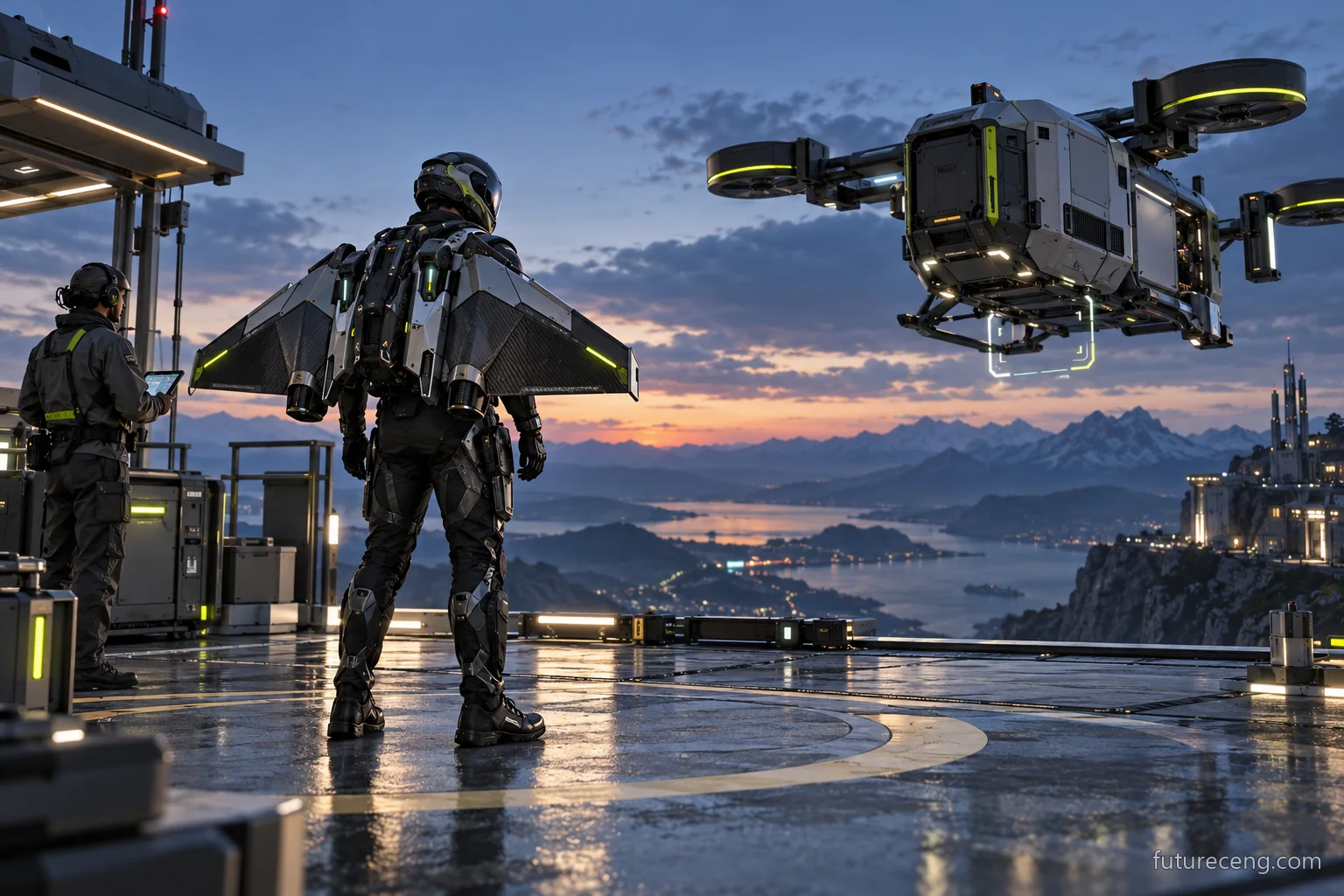 CONCEPT IMAGE
THINK ABOUT THE FUTURE DIFFERENTLY.As important as a man's wings, so is the support network behind him.
POSSIBLE EVERYDAY SCENARIOS
Technology matters
when it touches lives.
Let’s look at the intended experience through everyday life.
When the wings open
In the future scenario, he wears a user costume and is prepared for the experiment with the support of the team. The opening wings are the most visible moment of the idea of personal flight. The first simulation can explore how this preparedness and status information makes the user feel.
A support network in the sky
In the imagined journey, energy information appears along with appropriate service points. The network coordinates options while maintaining reserves. The coming and coming of a flying support vehicle is the long-term research goal of this story.
Preparing for the Road Again
At the service point on the ground, the technicians examine the condition of the suit and the maintenance records. The user can understand the next service; the support team is prepared for the next experiment. This flow describes the maintenance and service economy that surrounds the vision of flight.
How to change your name / Fly Human
Today's experience,
What's tomorrow's business?
What tasks can the experience in this work accomplish with new tools?
Behind the dream of a wearable flight could be data and ground support teams.
Fly Human; personal flight vision that combines automatic wings with a wearable jet system. When the fuel or charge decreases, information is considered to be transmitted to the support station network; while the air approach and refueling is not yet a confirmed service, but a remote research target. In this fantasy environment, the skills of aviation service technicians, logistics workers, and simulation instructors can be evaluated in different tasks. While repeated status records and support requests are automated, it may be important to recognize the missing information and make sure teams understand the same situation. The first area of study could be teams of experts studying the feasibility of virtual models, research simulations and on-site support services.
It maintains the status and maintenance records of the research defined by the experts, asks the relevant team for incomplete information, and maintains the traceability of the records. The aviation documentation discipline expands with new system knowledge. It assesses whether the technical file tells the same story as the virtual prototype; it contributes to the maintenance team's research by establishing a reliable information system.
The support network examines service demands on the ground, capacity records and timetables between teams in a planning environment. It records who receives and how the sample reports on the fuel or charge status are understood. The existing charting and field communication skills are expanded by training in the recognition of aviation context; the first task is to ensure that the demand in the simulation is shared among people in an understandable way.
In the research simulation, it observes how participants interpret status notices and support request screens. It brings the repeated confusions to the designers, reassessing whether the change is more understandable. Education and the ability to observe human behavior combine with data interpretation. It assesses the interaction of the virtual-level system with humans, together with a team of experts.
Where's the new business idea? Virtual prototype evaluation, maintenance data editing, support network modeling, and human interface research are services that can be explored around this vision. The first need discovery can begin by understanding what information the expert team lacks to make the decision. A real wearable flight test is not necessary to contribute; it may also be worthwhile to work on making a particular research question more understandable.
- Compile repeated maintenance and task records
- Combine support requests from different channels
- Manually classify similar simulation results
- Dressed Flight Maintenance Data Specialist
- Ground Support Network Coordinator
- Flight simulation assessor
- Human factors research assistant
- The Designer of the Flight Service Experience
- Aviation maintenance records and mission limits
- Simulation and logistics coordination
- Human factors and open communication
That's a proposed role. Working examples focus on simulation and on-the-ground service processes; actual flight and supply-related professional skills are required.
Read this transition and other projects in AI 4.0EVIDENCE ALONGSIDE THE VISION
Around the world today
how far have we come?
Gravity Industries offers wearable Jet Suit flights; Jetman's winged jet flights are also documented. The Boeing MQ-25 indicator is an example of inter-aircraft fuel transport on a different scale. These works do not make the automatic wing, the human costume and the autonomous flying power station into a single ready-made product.
The communication network can share the need for support and location; it does not carry the energy or fuel itself. The reinforcement requires a physical transmission system and the support vehicle's own energy account. The flight plan cannot be based on the complete depletion of energy; it must be considered along with the options of reserve, return and landing. The longer flight target must be investigated by weight, weather conditions, human factors, and nutritional conditions.
PRIMARY SOURCES · LAST CHECKED 26 OCTOBER 2026
A BIG VISION. A MEASURABLE FIRST STEP.
What could we
try first?
The first step could be a simulation that combines the flight experience and the support network. Energy notification, support request and landing options are assessed in a virtual environment. The service process on the ground can then be examined with a costume bag. This study shows the questions to be raised in professional aviation research and user needs.
A FEW MORE GOOD QUESTIONS
Questions worth asking.
Is Fly Human the same project as WingSu FlyCore?
No, I'm not. Fly Human describes a winged flying system worn by humans, and WingSu FlyCore describes a separate personal air vehicle approach. Although they both look at the same future, they're different design questions.
Will the support station be able to come in and reinforce?
That's the long-term goal of the user. The evaluated pioneers show wearable flight and air refuelling on other scales separately; no integrated automated assembly and refuelling evidence is provided for Fly Human.
Will backup be called when the charge or fuel is completely gone?
A flight concept cannot be based on this assumption. Planning, backup, and landing options are needed before the power drops. Network communication does not generate energy; the physical and operational conditions of the adapter must also be investigated.