FC—06WEARABLE HEALTH
Patient Monitoring Suit
Let care begin before the hospital door.
WEARABLE HEALTH AND CONNECTED CARE
Follow your health. Stay connected to life.
You go for a walk. While your clothing monitors selected data in the background, you do not have to keep checking a screen. When something changes, the right person can be notified.
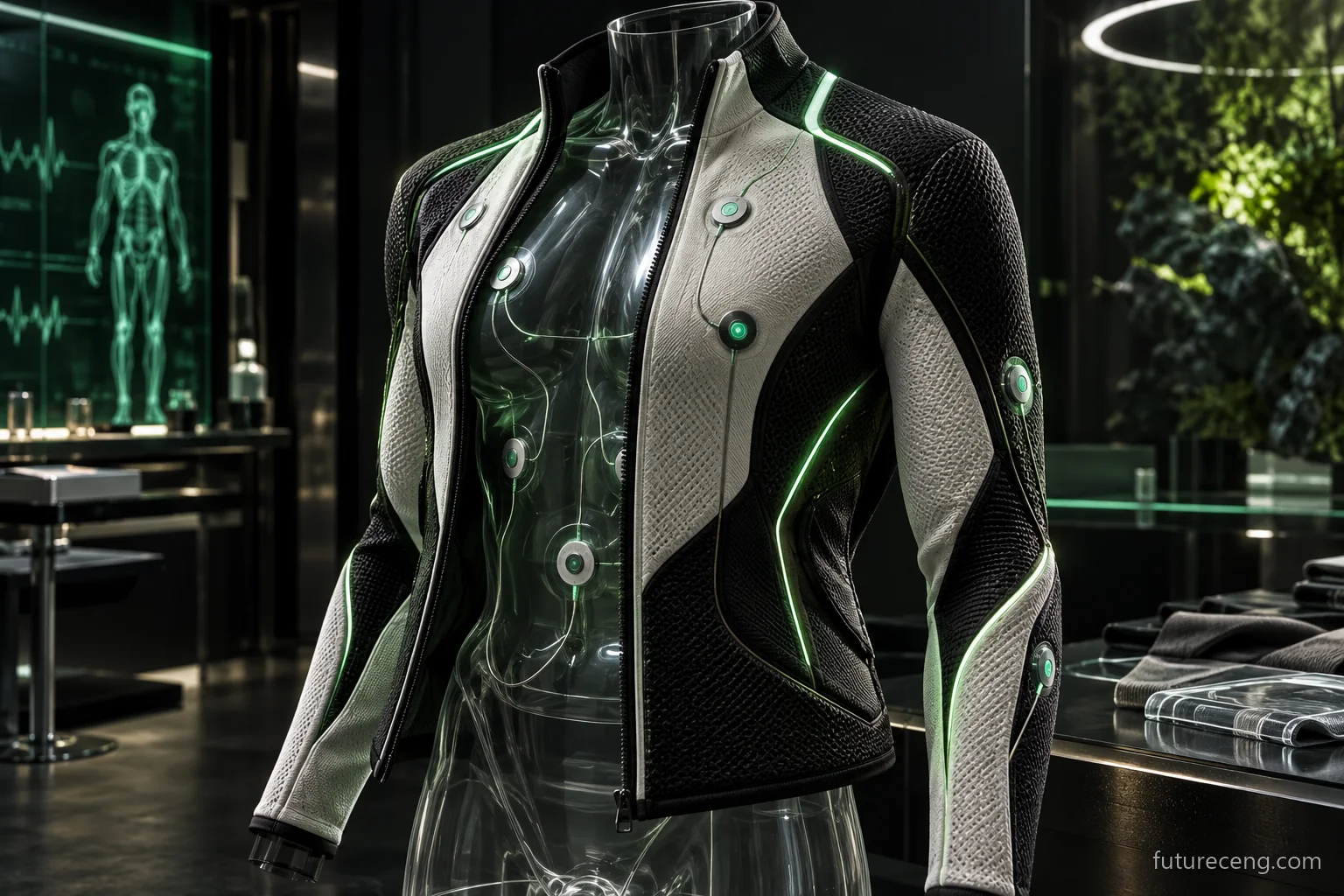
The pursuit of health can sometimes turn a person into a constant observer of his or her life. The starting question in Patient Monitoring Suit's vision is: How does the technology that supports you stand by you without forcing you to wait for an alarm at any moment? A comfortably worn layer can track specific signals with appropriate sensors; when there is a significant change, it can transmit information to the patient's pre-determined care network. It's not about turning life into a control screen, it's about promoting more confident participation in everyday life.
The idea of clothing requires an experience design greater than a single sensor. Measurement time, data quality during movement, battery status, and communication interruption are all parts of the same system. When the user sees a value, he should be able to understand what it means and when to consult his own care team. Instead of constantly worrying about notifications, we want to know who will be notified in what circumstances.
Automatic medicine, heating and physical intervention ideas in the first vision are long-term research headlines. There's no clothing available today with this project that continuously measures all blood values, distinguishes every patient, and chooses the right medication. A more meaningful first step is to focus on the needs of a specific patient group, combine appropriate sensor data with patient notifications, and develop a flow of communication that the clinical team can control.
Could health monitoring become part of everyday life rather than another device to manage?
As valuable as the invention of a new sensor, it can be to deliver the current measurement to the right person at the right time. The patient, loved ones, and the care team need different information. Instead of constantly flowing the same data to everyone, a meaningful summary can be prepared. The strength of the product may be that the whole experiment is understandable from measurement to reporting and that the individual has the right to decide on his or her own life.
THINK OF IT AS A SYSTEM.
Four parts.
One connected experience.
Select a specific need
Instead of a product covering each disease, a specific follow-up purpose is defined. Which data will work, by whom it will be evaluated, and in what circumstances it will be accessible to the user is considered with the maintenance team.
Get a reliable connection
Appropriate sensor measurement can be recorded with timing and availability information. Lack or low-quality data is not hidden; it's clearly shown what the system doesn't know at the time.
Make alerts meaningful
Notice that there should be no automatic response to every change in measurement. It is presented as information that can be evaluated by the care team in accordance with the clinically defined purpose of use and the appropriate communication plan for the individual.
Connect to the maintenance network
Families and healthcare providers allowed to see information about their roles. When the connection is disconnected or the device is removed, the situation is understood; silence is not presented as proof that everything is fine.
 CONCEPT IMAGE
THINK ABOUT THE FUTURE DIFFERENTLY.A dress, a bond, a feeling of confidence.
POSSIBLE EVERYDAY SCENARIOS
Technology matters
when it touches lives.
Let’s look at the intended experience through everyday life.
Home follow-up time
Clothes, after-hospital follow-up, edits the designated data. The patient can relate his or her condition; the care team can evaluate the description in the same way as the measurements. The data quality is also displayed together.
Relaxing a loved one
When the patient allows, the relative can obtain the necessary status information instead of the entire medical history. The balance between privacy and support is that sharing can be customized. The choices must be changeable in time.
A day out
Clothes are intended for use that does not interfere with daily movement. Issues such as battery and connection are clearly visible; the user does not have to guess whether the device is working or not. It makes sense to be prepared.
How to change your name / Patient Monitoring Suit
Today's experience,
What's tomorrow's business?
What tasks can the experience in this work accomplish with new tools?
From putting the device on, to building your daily care experience together.
If Patient Monitoring Suit improves, some of the day-to-day work of home care support staff, biomedical technicians and health data teams may change. Manual transfers of sensor recordings, one-on-one inquiries as to whether the device is connected, and the preparation of similar status messages can be more automated. In contrast, understanding why clothing is not used, providing understandable assistance to the patient, and conveying low-quality data to the health team in context requires human input. A support worker who knows a patient's daily habits can detect problems with the product that are not on the table. Instead of forcing the person to keep looking at the measurements, the new area of work is to place the device in a maintenance-friendly and livable manner.
It tracks the status records of the device, connectivity issues and maintenance needs within its authority. It assesses with the relevant team whether a problem is due to usage habits or a technical defect. Regular recording and fault communication skills from service work expand with wearable system training, supporting technical usability without assuming clinical interpretation of measurements.
It helps to understand the interface between the patient and the loved one, collects recurring use problems and communicates them to the appropriate specialist. It tells you where to view the notifications, sends your medical questions to the care team. Daily listening and patient communication skills, along with accessible training preparation and knowledge of data privacy can be at the heart of the new role.
It analyzes the timing, source, and missing intervals of data, comparing how the same record looks in different systems. It ensures that any uncertainty is not hidden in the file that the clinical team will use. Recording accuracy is complemented by training in understanding the limits of sensor data. So instead of just filling out the chart, everyday work moves to making it clear what data the health team is looking at in what context.
Where's the new business idea? The coordination between user training, device support, data quality and maintenance teams can become separate service titles. The first research could focus on understanding what users left the system in and what help returned. It is also worthwhile that the product can be used sustainably until it is sold, which requires small, observable trials with the patient and care team to demonstrate.
- Manually transferring sensor records
- Preparing similar status reports one at a time
- Manually check the connection status
- Wearable health system technician
- Remote Care Flow Coordinator
- Health sensor data quality specialist
- The Teacher of Sick Device Experiment
- Clinical Warning Assessment specialist
- Sensor data and measurement limits
- Patient communication and data privacy
- Device installation and connection tracking
Clinical evaluation and intervention authority rests with trained health professionals.
Read this transition and other projects in AI 4.0EVIDENCE ALONGSIDE THE VISION
Around the world today
how far have we come?
ZOLL LifeVest is an example of a wearable device that can monitor specific rhythm disorders and apply shock therapy. Autonomous insulin systems also offer sensors and drug delivery cycles focused on a particular disease.
General purpose clothing, which constantly measures all blood values and chooses the right medication mix in every emergency, is not proven by these examples. Automated treatment by monitoring and reporting requires different development processes.
PRIMARY SOURCES · LAST CHECKED 26 OCTOBER 2026
A BIG VISION. A MEASURABLE FIRST STEP.
What could we
try first?
Pick a single group of patients. Design an initial version that combines data from validated existing sensors with patient notifications, providing alerting and emergency communication to the care team.
A FEW MORE GOOD QUESTIONS
Questions worth asking.
Can this outfit predict all illnesses?
No such ability is claimed. The first step of the concept should be limited to a specific use and appropriate patient group. The data that sensors can measure, the clinical evaluation, and the patient's narrative can complement each other; the fact that measurements are available does not mean that every health problem can be understood. Each purpose of use must also be evaluated by experts.
Will the clothing give itself adrenaline or any other drugs?
General-purpose automatic drug administration is not presented as a ready-made feature. Such physical interventions require separate clinical research, device development, and expert evaluation. The proposed first version focuses on an experiment that can be controlled by the maintenance team through monitoring and communication. Advanced intervention ideas should also be explored.
Doesn't constant follow-up increase anxiety?
It's an important design question, and it should be at the heart of user research. More notification doesn't always mean better support. The user should know what he is watching; the communication pattern defined by the maintenance team and the understandable status information should aim to reduce the need to constantly look at the screen. A person's preferences should remain visible in the process.