FC—16THE TOUCH OF VIRTUAL UNIVERSES
VR AI Simulations
Put on the suit and headset. Build your own universe.
AN EXPERIENCE BEYOND PERSONAL UNIVERSES / IMAGERY
From entering a game to building your own universe.
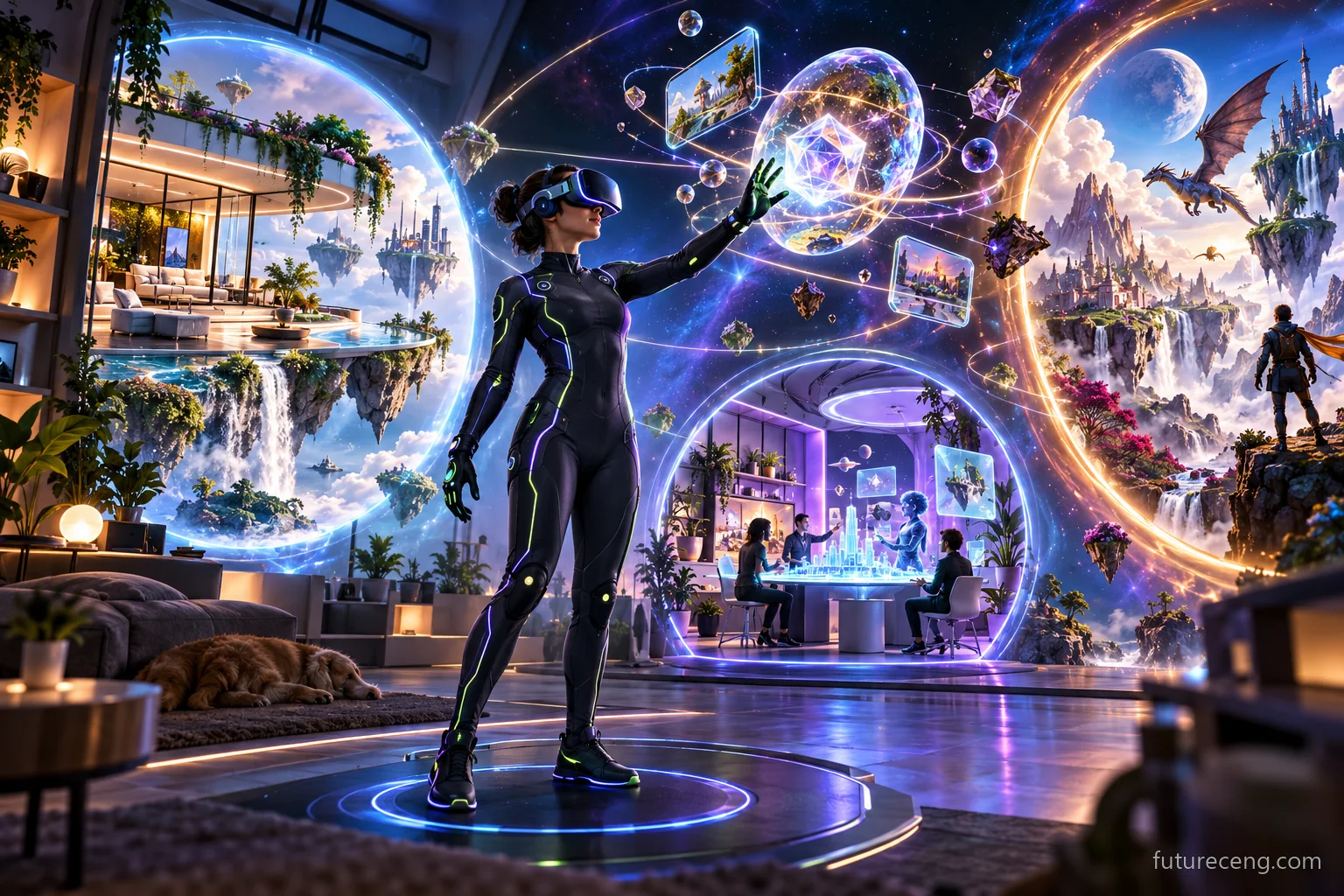
You put on the suit and headset. A personal hub welcomes you: the home you designed, spaces where you can work and doors into different games. You help decide what this universe becomes.
VR AI Simulations thinks of a personal digital space that doesn't depend on a single game. The user is asked to set up their own home, choose their favorite scenery, invite their friends, move from the same center to a game, meeting or creative workshop. Artificial intelligence can help develop scenes, objects, and characters while building this field. A person's preferences, shared boundaries, and the rules of the world are part of the experience.
Clothes, gloves, and helmets make up the interface between this world and the body. Supported touch, vibration, movement, or muscle feedback can be added to the image and sound. It aims to create a stronger sense of presence by reacting to an object, performing an action with physical movement, and sharing the same experience with someone else. But feeling everything as it is in real life is not a complete technology package today; it must be clearly stated which feedback is being provided.
So the value of the first product could be in the performance of a small experiment before the promise of an infinite universe. Is it easy to design a room? When the user walks through the door, does he know which world he's going to? When you're physically stationary, is virtual interaction understandable? As much accessibility as content creation, comfort, session control, and community experience are fundamental design questions of the personal universe.
Could a virtual world become a place you shape and inhabit, rather than simply look at?
It can open up new experiences for users to create their own domains, design the world, virtual activity, learning and working together remotely. It's just as important as ready-made scenes, personal editing tools, understandable interaction with different devices, and creators being able to share their work. Here, artificial intelligence is seen as an assistant that reduces the burden of production without depriving humans of the right to choose what they want.
THINK OF IT AS A SYSTEM.
Four parts.
One connected experience.
The physical interface
The headset, hand tracking, and appropriate tactile clothing are all connected to the same experiment. Supported feedback types and the user's stop/control capability are clearly designed.
Personal home and centre
Adjusts the user's location, appearance and sharing. Artificial intelligence can help create content; personal preference and creative control remain with the user.
Worlds open to play and work
It moves from the center to different simulations, games, or workspaces. It's easy to see who it's shared with and what rules the world works by.
The team that developed the experience
Worldwide designers, touch experience developers and community teams evaluate user feedback. Instead of claiming absolute reality, defined experiences are tested.
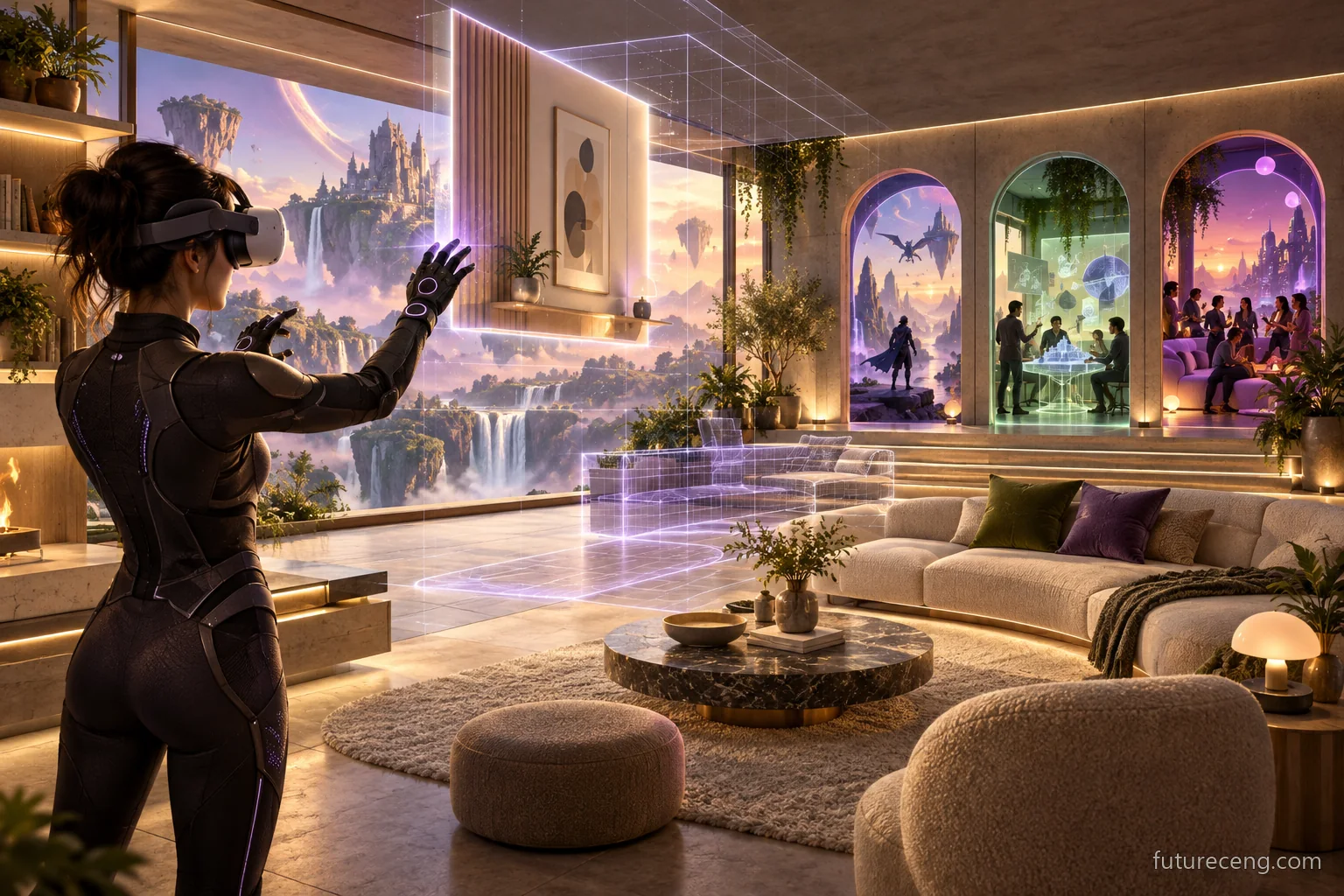 CONCEPT IMAGE
THINK ABOUT THE FUTURE DIFFERENTLY.From entering a world, designing your own world.
POSSIBLE EVERYDAY SCENARIOS
Technology matters
when it touches lives.
Let’s look at the intended experience through everyday life.
Build the house of your dreams
The user changes the location of the room and the view outside. It starts with the available options and builds its own order; it's up to AI to accept or change suggestions.
Creating something together
Two people enter the same virtual workshop and work on a common object. Supported tangible events accompany the interaction; not assuming that all the force and material properties of real objects are transmitted.
Moving from the center to the adventure
The user chooses the door to a game from his personal area. Once out of the game, it returns to its own domain; session, privacy, and device-enabled feedback are understandably managed.
How to change your name / VR AI Simulations
Today's experience,
What's tomorrow's business?
What tasks can the experience in this work accomplish with new tools?
From the game screen to designing the experiences people will live in.
With a full-touch outfit and a headline, the vision of entering one-to-one worlds can engage game designers, test staff and community teams with new questions. In a universe where the user builds his own home, passes through portals to work or playgrounds, it is not enough to design images; it is also necessary to explore what the person understands and how he feels. Today's limited tactile feedback is not the same as the experience of performing all the senses perfectly. However, things like world organization, accessibility, experience testing, and activity coordination can already be thought of around virtual prototypes. As repetitive stage preparations become automated, making choices that make sense to the world and keeping track of the boundaries of different users can be an important part of the human contribution.
They design virtual layouts where the user can change their home and move to different areas. They examine direction, accessibility, and how personal preferences are preserved while leaving repeated decorative preparations to vehicles. The flow of gameplay and the narrative experience expands with user research; everyday work focuses more on understanding why people want to stay in a world than on placing objects.
It examines how the user matches the on-screen event with limited feedback provided by the appropriate research equipment. It records inconsistencies, misunderstandings, and moments when personal preferences are lost. The ability to detect detail and prepare repeatable tests combines with the knowledge to observe human experience. The evaluation also includes the user's response to the request to pause or withdraw in the interface.
It can connect user-generated worlds to exploration areas and shared activities. Evaluates for whom a business meeting or game event is accessible, and the participant transfers feedback to the design team. Existing moderation, programming and communication skills expand with the virtual space experience. The new role is just as important as sorting out content, so people can come together while maintaining their own boundaries.
Where's the new business idea? Personal world design, accessible virtual activities, user research and limited touch experience assessment can be explored as separate service areas. The first discovery is to understand why a user wants to create their own domain and what they're losing as they move on to other worlds. A small prototype can show which experiment is really useful or attractive without solving all of the sensory technology.
- Repeated stage and decor preparations
- Manually classify similar session tests
- Activities and world entries are organized separately
- Immersive World Designer
- Touch experience evaluator
- The curator of the virtual universe
- VR Accessibility Designer
- AI simulation content developer
- Game and space experience design
- User research and understanding of device boundaries
- Community, accessibility and session control
Titles are possible role suggestions. Full sensory reality with supported tactile events is of varying levels; the demand for work depends on the experiment developed and actual use.
Read this transition and other projects in AI 4.0EVIDENCE ALONGSIDE THE VISION
Around the world today
how far have we come?
TESLASUIT offers electrical touch feedback and muscle alerting; bHaptics vibrational feedback; and HaptX offers products on hand-held touch and resistance. VRChat supports users to create their own worlds. These pieces are real examples, but they do not show that the same system reproduces all the senses and real physical forces infinitely.
The focus of this project isn't just one game, it's getting the person to combine play, work, social space, and their home in the same personal universe. Artificial intelligence can help produce content; humans set the world's rules, privacy, and sharing. Vibration, touch, muscle stimulation, and actual weight are not the same experience; it should be clearly defined which sensation is provided by which device.
PRIMARY SOURCES · LAST CHECKED 26 OCTOBER 2026
A BIG VISION. A MEASURABLE FIRST STEP.
What could we
try first?
A virtual prototype can be made with a private room, a small shared space and a single game or work assignment. Several defined events are investigated with a ready-made title and supported touch equipment; world creation, transitions, accessibility, latency, and user comfort are evaluated. Physical feedback on clothing is also dealt with with appropriate expertise and manufacturer use limits.
A FEW MORE GOOD QUESTIONS
Questions worth asking.
Can we communicate all our feelings today as in the real world?
No, I'm not. Existing touch systems provide certain types of feedback. Vibration, skin sensation, muscular stimulation and actual physical resistance are not the same thing. Full and unlimited sensory transmission is a long-term vision.
Is this a game or a workspace?
The vision is to bring the two of them together in a personal center. The first prototype can start with a single room and a single mission; shared experiences and worlds are developed separately.
Is AI going to design everything for me?
It could help produce artificial intelligence. But choices like what space to set up, what to share, and who to join the world are considered part of user control.