FC—05MOBILE CLINICAL ROBOTICS
Nurse Robot
A welcome at the entrance. A listening companion. A handover to your doctor.
TRAVEL TO THE DOCTOR / MOBILE PATIENT FROM THE HOSPITAL ENTRANCE
“Please take a seat.” A hospital journey that starts by listening to you.
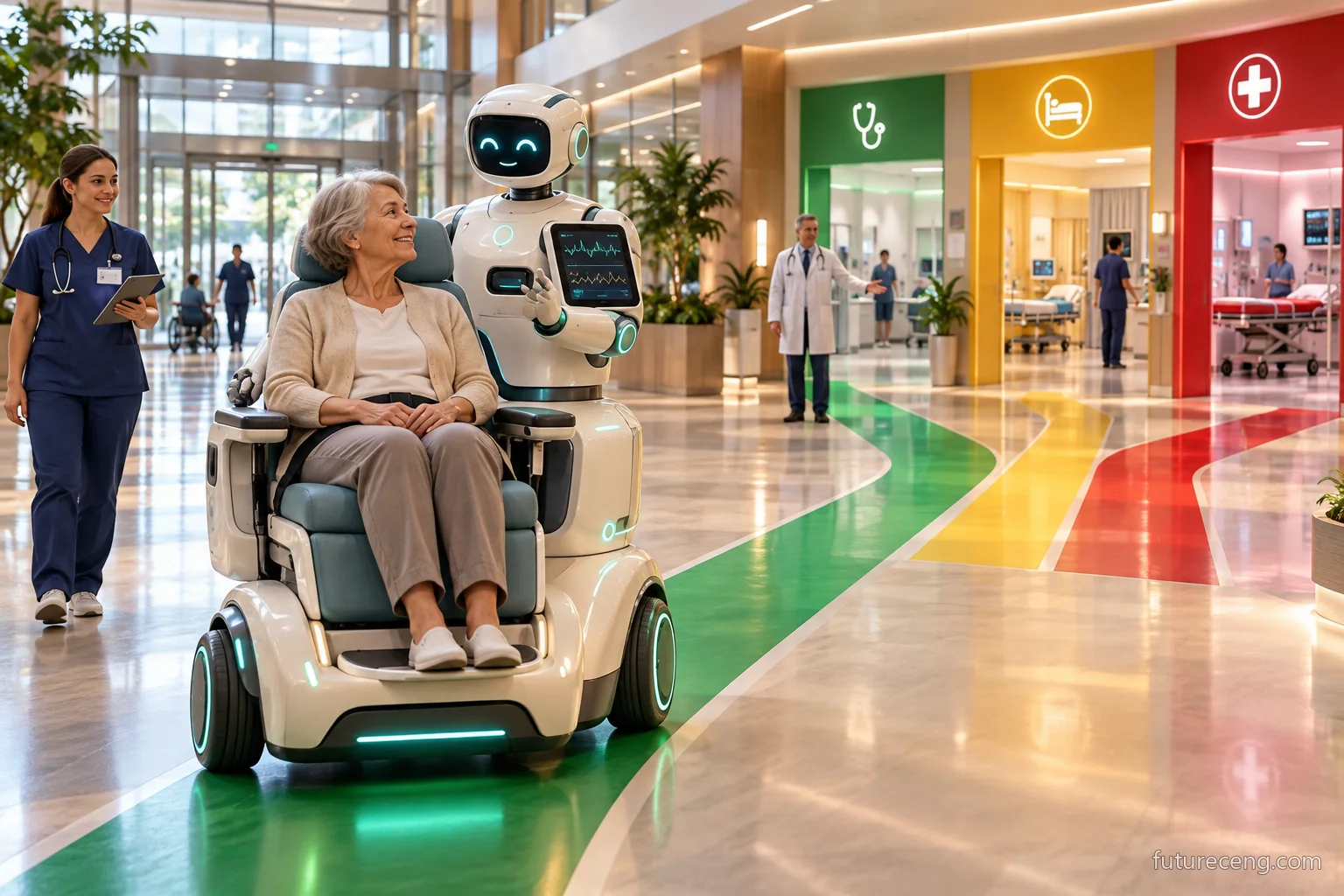
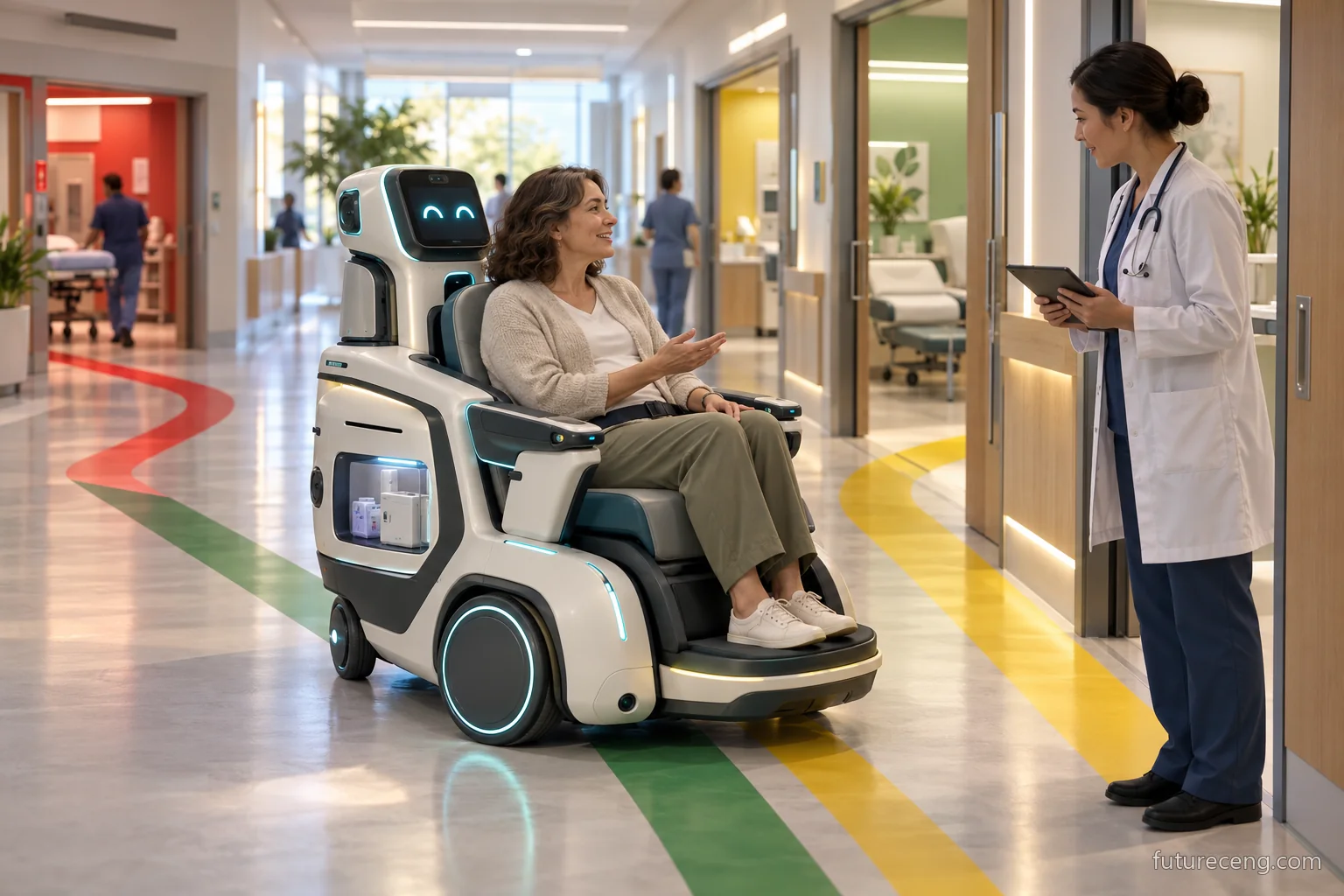
A robot welcomes you at the hospital entrance. Once seated travel is judged suitable, you take your seat. As the robot accompanies you, it listens to your symptoms and prepares information for the healthcare team.
The robot is waiting at the entrance to the hospital where the patient is coming. The wheelbase, seating area, understandable communication surface, and clinical components are all thought to be parts of the same mobile system. The robot invites the person to sit down, and the appropriate patient can sit down and move around and get acquainted with the units in the hospital and the process to be followed. The patient needs to be able to understand where he's going and what's going on, thanks to the accompanying system.
During the trip, complaints and past records that the patient has agreed to share can be combined. Data from appropriate measuring devices and previous blood tests are attached for examination by the health team. New sampling and the idea of a small lab are part of the vision, but no blood samples are taken during transportation. Standing, professional supervision, and separate verification of components are required for physical operations. The scope and timing of the results are not promised as a ready-made feature.
The green, yellow, and red lines in this narrative show the pathways to the hospital's different clinical priorities. These aren't rounds completed in sequence. The clinical team determines the patient's priority and suitability for transportation; hospital admission, routine interviews, or waiting for results at an emergency risk are discontinued. The goal is to alert the team immediately and provide a swift response to the appropriate response area. During a calmer flow, the patient is rested, information is prepared, and a more regular file is sent to the doctor.
SEPARATE ROUTES ACCORDING TO CLINICAL PRIORITY
Green area
The clinically appropriate, lower-priority flow information and guidance experience can be considered.
Yellow field
Flow that requires prior evaluation. The robot's route and waiting steps are regulated by clinical decision.
Red field
Emergency evaluation and response priorities. Routine tours or tests are targeted at health teams who do not expect results.
The colors don't show the order of visits. Priority, transportation suitability and clinical decision are assessed by the health team.
Could a patient’s information be ready by the time they reach the right clinical team?
Acceptance, direction, story taking, measurement, and result sharing often take place at different times. The idea of a mobile robot gives you the opportunity to think about them in one go. The AI, which explores possible explanations, can reveal uncertainties and points that the doctor needs to ask again; the automated summary does not replace the precise diagnosis. Designing patient communication together with clinical authority could be a more meaningful start than a beautiful looking machine.
THINK OF IT AS A SYSTEM.
Four parts.
One connected experience.
Accept and accompany
The patient understands what's going to happen, shares his preferences. When it is convenient to move in a sitting position, it is considered to be carried on the mobile platform and to be accompanied by staff on the chosen route.
Listen and combine the information
Complaints, shared history records, and appropriate measurements are handled together. A file with a known source, time, and absence is being prepared for the clinical team.
Assess the control at the stop
Blood samples and small laboratory components are studied as separate and supervised steps from movement. The results are combined with the existing file; the scope of the physical operations is also verified.
Prioritize referral to a doctor
Emergency risk team warning and timely alert to the appropriate area. In other flows, the story and the results are presented to the doctor; the clinical decision is made by the competent team.
 CONCEPT IMAGE
THINK ABOUT THE FUTURE DIFFERENTLY.A journey from the hospital entrance to the right medical team.
POSSIBLE EVERYDAY SCENARIOS
Technology matters
when it touches lives.
Let’s look at the intended experience through everyday life.
The first time you came to the hospital
A patient is greeted at the entrance and, if deemed appropriate, carried by sitting. As you go to the unit, the robot tells the process, listens to the person and prepares the basic information for the team. Introduction is limited to the flow that clinical priority allows.
Next to previous analyses
The patient agrees to share his past analysis. The robot connects them to new measurements and complaints with its time and resources. In addition to the summary, the doctor may examine the original records.
When the priority of the flow changes
When a risk warning is issued, routine information collection is not attempted. The health team is notified and the timing is targeted at the appropriate area that the team is evaluating. The robot's ability to intervene is not presented as a proven independent treatment in this concept.
How to change your name / Nurse Robot
Today's experience,
What's tomorrow's business?
What tasks can the experience in this work accomplish with new tools?
It's a team that moves through the hospital door with the doctor and the patient.
Nurse Robot is thought to be a wheelchair hospital escort carrying a patient in a chair. The reception team at the entrance can set up a mobile service that prepares the patient's narrative, the history he allows to share, and appropriate vital metrics for the doctor's appointment. While rewriting the reception record and transmitting the same information to different units is automated, it maintains the importance of listening to the patient and having an open session between teams. The green, yellow, and red directions are based on the priority chosen by the clinic, not proven independent triage ability. In the case of red, the tour or study should be upgraded to an official team before completion is expected. Initial procedures, such as blood transfusions, are considered separately, at a standstill, and under the supervision of specialists, rather than during movement.
It helps the patient understand the moving companion, listens to communication preferences, and directs questions to the appropriate specialist. It follows that the doctor or unit designated by the team is understandable on the record. Quiet communication from the experience of reception, accessible service, and recording accuracy are expanded by robotic learning; understanding what will happen during the journey and reaching out for human support when needed is at the heart of daily work.
It monitors the status records, maintenance needs and non-use notifications of the wheeled system under its authority. Comparing the reception team's observations to the technical file, the Robot Nurse coordinates work with the Care Specialist. The device tracking experience expands with mobile robot knowledge. The day-to-day task is to make sure that the patient's team is clearly aware of the vehicle's current status and who they will turn to for support.
It evaluates the patient communication of the active companion, the physician cycle, and how the priorities chosen by the clinician are understood at the interface. It observes the sharing of responsibilities of employees with controlled scenarios, transferring mixed statements to the product team. It combines nursing and team training experience with feasibility research, working together on how to adapt technology to hospital flow and human supervision without transferring clinical authority to a robot.
Where's the new business idea? Services that can be investigated for hospitals may include mobile patient escort, team training, robotic care coordination and evaluation of doctor-time experience. The first discovery is to observe where the patient repeats the same information from the entry to the interview, and at what transition he needs human support. A small, supervisory pilot can show which real service gaps can be closed before adding work to the technology.
- Do not rewrite the same patient history
- Manually edit routine measurement records
- Collect the information about the preparation of the repeated operation
- Robot Nurse Assistant
- The Robot Nurse Technician
- Nurse Robot Maintenance Specialist
- The Robot Nurse Trainer
- Clinical workflow and patient communication
- Limitations on medical device use and maintenance
- Privacy of health data
A trained nurse carries clinical responsibilities.
Read this transition and other projects in AI 4.0EVIDENCE ALONGSIDE THE VISION
Around the world today
how far have we come?
In emergency service statements in Turkey, green, yellow and red areas are associated with the patient's clinical priority; the assessment is based on trained health personnel and medical supervision. The FDA has authorized the use of the Aletta robotic blood tracker under the supervision of trained professionals in adult patients. This example does not validate an integrated mobile robot that takes blood in motion and provides independent emergency care.
The value of the robot is not just to carry the patient; it can be to combine reception, listening, storytelling, measurement, and outcomes in a single, understandable journey. Colors are not routine stops. The clinical team determines priority and suitability for transportation; no introduction or test results are expected in case of risk. Responsibility for diagnosis and treatment rests with the competent medical team.
PRIMARY SOURCES · LAST CHECKED 26 OCTOBER 2026
A BIG VISION. A MEASURABLE FIRST STEP.
What could we
try first?
A hospital scenario can be simulated first: reception at the entrance, seating of the appropriate patient, escorting staff to the selected area, gathering information at the station and briefing the doctor. Moving transportation and physical sampling are evaluated separately. In the first prototype, human supervision, comprehensible approval, emergency warning and patient experience are verified; physical clinical procedures are also developed.
A FEW MORE GOOD QUESTIONS
Questions worth asking.
Is the robot really a system that carries the patient sitting?
Yes, the current vision is a mobile patient reception and escort robot. The seating area and wheelbase are thought to be in the same system. It's a matter of clinical evaluation as to which patient can be transported in this way.
Are we going through all the green, yellow, and red areas in a row?
No, I'm not. The colors indicate the clinical priority areas. The area required is determined by the health team; no introduction and routine procedures are expected in emergencies.
Is he ready to take blood while he moves and treat himself?
These integrated abilities have not been proven. Blood transfusion is treated as a separate and expertly monitored component of movement. It's not the same thing as an emergency response and independent treatment team; the responsibility for diagnosis and treatment rests with the competent team.
Can you add other features like X-rays?
The imaging may be one of the first research headlines in the vision. But X-rays require separate equipment, expertise, and evaluation. The mobile robot isn't shown as a feature that's ready to be used in every situation.