FC—11PLANETARY ROBOTS
The Koloni
Let robots take the first step for us.
ROBOTIC DISCOVERY FOR PLANETS
They go first to ask the right questions.
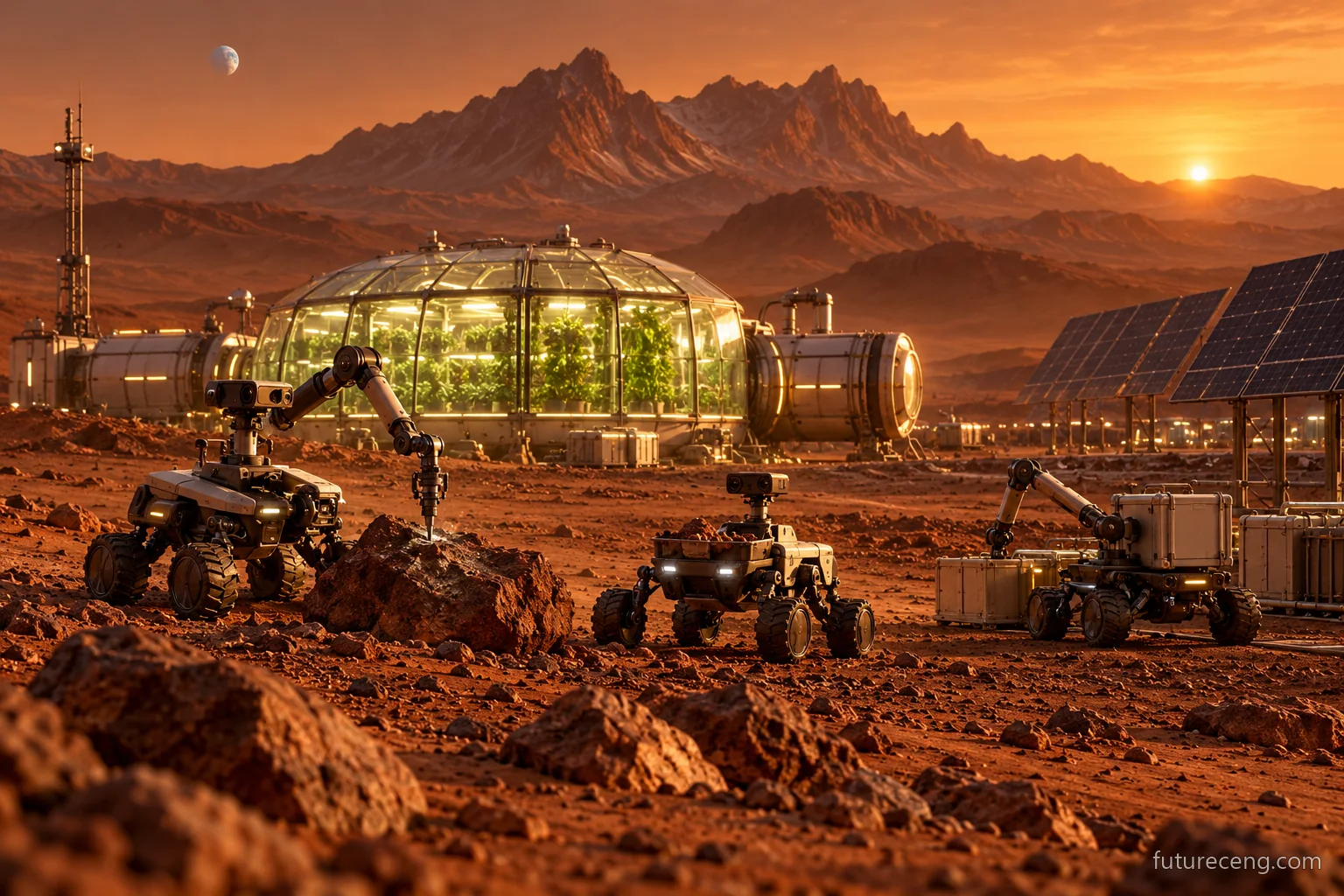
Two small robots set out across unfamiliar ground. One maps the surface while the other studies energy and environmental data. Their first task is to learn where a colony would be unsuitable before attempting to build one.
The Koloni, a vision for the future of small robot teams to work before human settlement. These robots can observe the surface, compare different regions, and collect questions for habitat design. The beginning of the dream is not a big city, but reliable information to make a decision. Whether it's underground or on the surface, how can energy be maintained, which part is difficult to maintain? These measurements should determine the direction of design.
The idea of a colony begins visually with buildings; it continues operationally with maintenance, energy and uncertainty. So we want to think of robots not just as exploration tools, but as a team sharing repetitive tasks. One robot can observe the environment while continuing its mission; when communication is interrupted, it can determine which task will be postponed. Artificial gardens, modular areas, and resource use can be research topics that are linked to this shared mission architecture.
The Koloni is not based on the assumption that humanity must leave Earth. Understanding new environments, developing systems that can work remotely, and rethinking the necessities of life are in themselves valuable goals. We're not saying we're offering a working planetary colony today. The first step closer could be that two small robots on Earth share a shared mapping and greenhouse monitoring mission. A big vision can be built on a small, observable experiment.
Before building a place to live, could we listen to what the environment tells us?
The specific area of this project might be to explore how limited tools work together, rather than a single multi-talented robot. When mapping, energy tracking, and a small cultivation area meet in the same task plan, the interdependencies between the systems become apparent. This information can raise new questions beyond the idea of distant planets, but also about maintenance and remote business design in hard-to-reach areas.
THINK OF IT AS A SYSTEM.
Four parts.
One connected experience.
Observe first.
Robots may try to turn the mission area into a shared map. It records where and under what conditions the measurement was taken, clearly separating the area seen from the area not yet explored. Uncertainties remain visible on the map.
Team up the task
Each robot's ability and energy state can contribute to the assignment. Stopping a car doesn't mean stopping the whole plan; it's pre-determining which tasks can be delegated and which ones can wait.
Make a little life experiment
In a controlled order on Earth, greenhouse monitoring, modular piece transport, or environmental measurement can be attempted. The robot's job is not to show that it solves the entire life system, but to investigate the continuity of a particular task.
Move what you learn back to design
Energy consumption, maintenance needs, and communications interruptions will be examined as part of the task. The next design feeds not on the visual imagination, but on the real boundaries encountered in the small experiment and the recordings obtained.
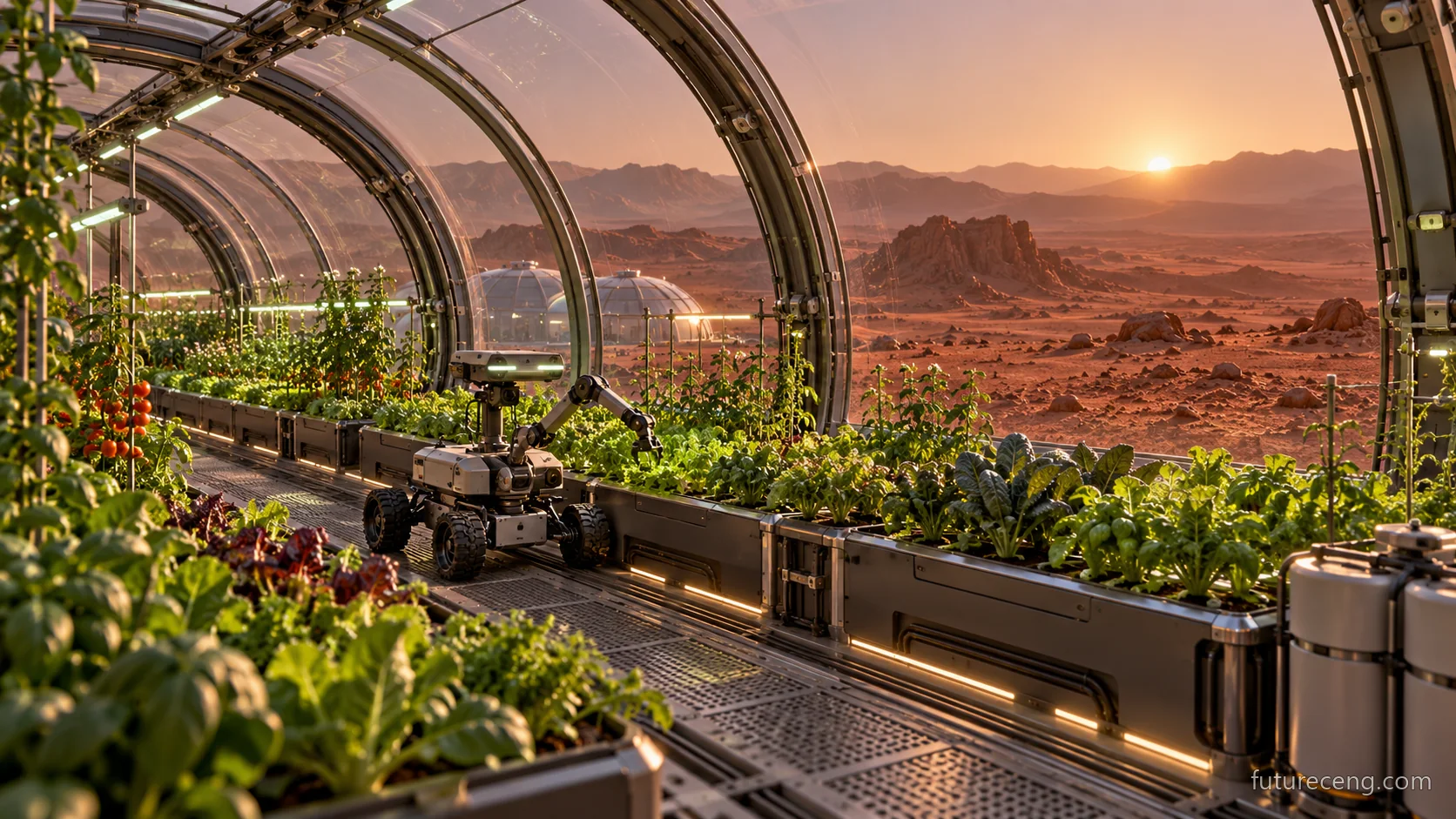 CONCEPT IMAGE
THINK ABOUT THE FUTURE DIFFERENTLY.Before you live on a planet, understand it.
POSSIBLE EVERYDAY SCENARIOS
Technology matters
when it touches lives.
Let’s look at the intended experience through everyday life.
Two robots, one map
In an experiment on Earth, robots scan different sections and combine their findings in the same area. Disagreeing observations are not hidden; they can be marked as points to be re-examined. The shared map is reshaped with the learned.
When the communication is interrupted
The team will test which mission to continue and when to wait when the connection is not in place. It makes autonomy more meaningful than a demonstration designed as if there were uninterrupted communication. Mission boundaries can be reassessed by comparing them to records.
Watch the little garden
One robot can try to carry the other while watching the controlled cultivation field. Environmental data, energy and maintenance can be evaluated together in the same task log. The need for maintenance can directly feed the next design.
How to change your name / The Koloni
Today's experience,
What's tomorrow's business?
What tasks can the experience in this work accomplish with new tools?
Field skills on Earth can be transferred to remote mission research tables.
The vision of The Koloni can open up new questions not only to people working in space, but also to people with experience in mapping, farming, maintenance and remote field management. One-by-one recording of environmental measurements, identifying similar landscapes at an early stage, and manually combining robot logs can be done more automatically. Instead, it may be important to understand the context of the measurement, to accurately describe the need for maintenance, and to evaluate the sharing of tasks among robots. The daily observations of a greenhouse technician or the habit of a field worker noticing a missing record may contribute to controlled robotic experiments on Earth. No need to wait for work on another planet for the first study; similar questions can be discussed in small research papers.
It compares the time, location and uncertainty of measurements from different robots. It provides a comprehensive record to the research team for re-examination of inconsistent areas on the shared map. The ability to interpret field data and work with location information is enhanced by training in understanding robot logs, making the difference between a beautiful-looking map and a reliable research record visible.
In a controlled breeding experiment, it evaluates the environmental information collected by the robots along with daily observations. It conveys the difficulty of use, the need for maintenance and the lack of data points to the research team. Experience with plants and the working environment combines with robotic system literacy; the new role may focus on understanding which information actually works in a remote-controlled system.
The research system tracks energy, maintenance and availability records, determining what information the team needs when access is difficult. The habit of regular checks and open fault reporting in the current workplace is shifting to a different experimental environment. Along with training in robotics and environmental systems, it can play an important connecting role in informing designers of the unseen continuity needs of everyday work.
Where's the new business idea? Data evaluation, robotic greenhouse experiments, simulation and remote maintenance support can be investigated for research facilities on Earth. A team may first ask what expertise they lack. Contributing to the planetary vision can begin by making a specific measurement, maintenance record, or shared mission experience more understandable, rather than undertaking to build up the entire living space.
- Manually save repeated environmental measurements
- First classify similar landscapes
- Combine robot task logs one by one
- Task coordinator for the planetary robots
- Robot Swarm Simulation Specialist
- How to use remote habitat system technology
- Robotic greenhouse operation specialist
- Scanning data quality assessor
- Planning and simulation of robotic tasks
- Energy and maintenance tracking
- Interpreting the environment data
Job demand depends on the development of tasks; engineering and environmental assessment require relevant expertise.
Read this transition and other projects in AI 4.0EVIDENCE ALONGSIDE THE VISION
Around the world today
how far have we come?
NASA CADRE is developing small lunar robots that will explore autonomously together. ARMADAS offers a research example showing how modular parts can be combined with robots.
These aren't working human colonies. Separate opportunity to link site selection, energy, greenhouse and maintenance tasks to a common task plan; to base underground or surface selection on measurements.
PRIMARY SOURCES · LAST CHECKED 26 OCTOBER 2026
A BIG VISION. A MEASURABLE FIRST STEP.
What could we
try first?
Earth mapping, energy budgeting and small greenhouse tracking with two little robots. Test how the mission sharing went during the communication interruption.
A FEW MORE GOOD QUESTIONS
Questions worth asking.
Is The Koloni building a real planetary colony?
No, not at this stage. The concept focuses on small teams of robots that can provide information for future settlement research. The visuals represent a vision. The first concrete work could be to try to do a limited task together on Earth, such as sharing mapping, energy tracking, or greenhouse monitoring. The results could fuel the next design.
Why do we think of small robots instead of one big robot?
The sharing of tasks by multiple vehicles raises different questions to explore: What skills are needed where a robot stands, how is the information combined? It's not supposed to be any better anyway. Small experiments can compare the real benefits of work and maintenance. He needs to experiment with which approach works.
Are you planning a habitat on the surface or underground?
This page doesn't pick a spot. The idea is to base the design decision on the data of the environment being studied rather than a visual preference. The requirements for surface and subterranean options can be different, and the value of robot discovery lies in turning these differences into more concrete questions. The starting goal is to be able to produce better questions.