FC—14TINY CAPSULE / FOOD EXTRACT
Every Day 3 Gre-eat
Choose a flavour. Imagine nutrition in a tiny capsule.
TASTE, NUTRITIONAL ESSENCE AND A TINY FORM / VISION OF THE FUTURE
Carry the nutrients, rather than the shape of the food.
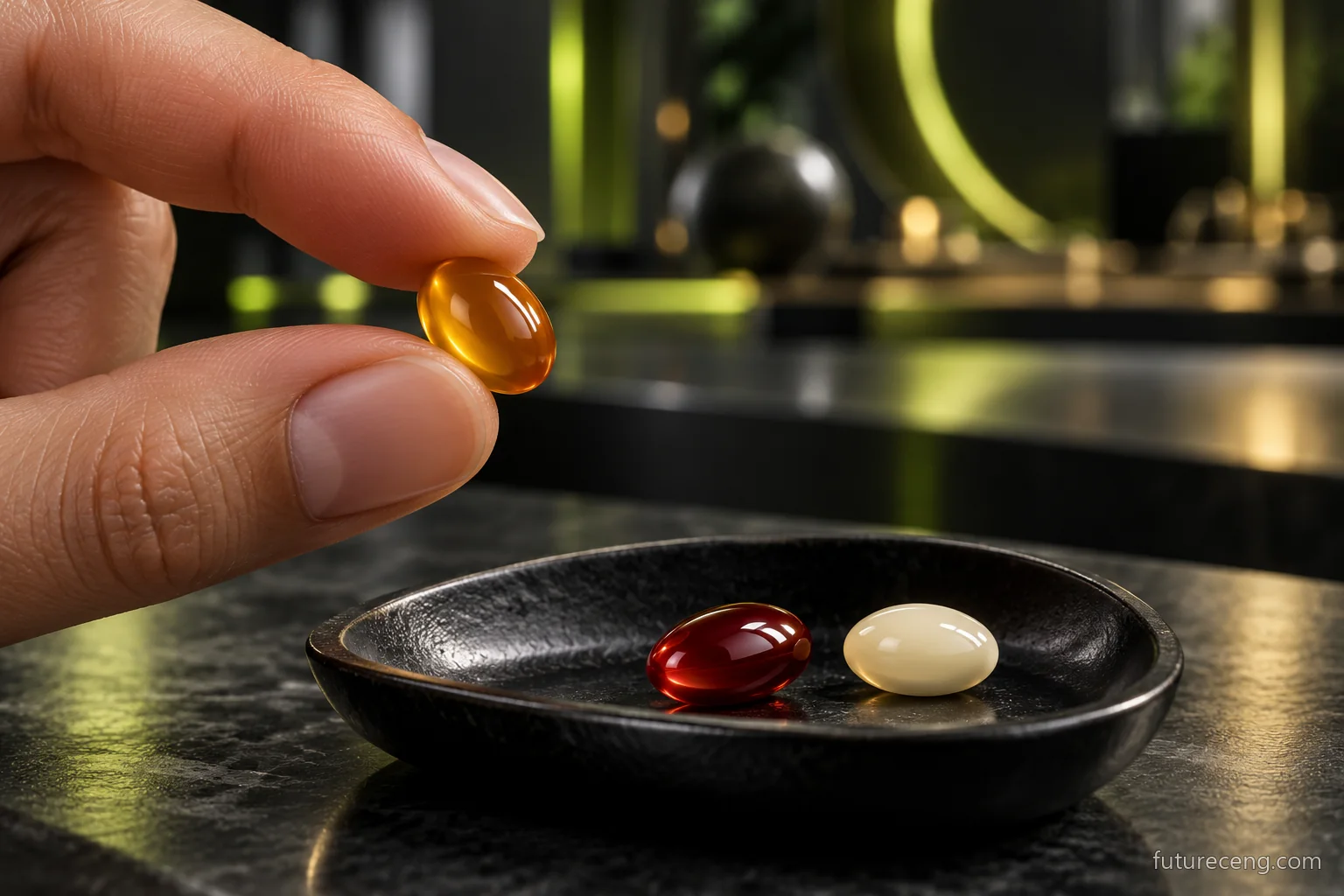
A tiny capsule rests between your fingers. You choose the flavour. The concept imagines a concentrated nutrient form you could consume by sucking or swallowing.
At the heart of the design of Every Day 3 Gre-eat is a very small, homogeneous capsule. Instead of transporting food as we know it, the idea is to deliver the nutrients that you want to get from it. The capsule is not intended to contain any visible food particles. Appearance and taste options can vary; what comes into the user's hands is a small capsule again. Water, on the other hand, is a separate drink and a necessity.
The example given by Cenk is very clear: "Take everything you can get from 250 grams of meat in a tiny capsule, filtered". This phrase describes the transformation that the project is aiming for, not the equivalent of a food produced today. Water, tissue, and certain components of a food can be distinguished. But proteins, fats, carbohydrates, and other nutrients that are meant to be preserved are also physical substances. Absorption doesn't eliminate the amount they need. The biggest question in this study is the relationship between the very small form and the amount of nutrients and energy.
Taste selection is a distinct design area in this vision. It is desirable that the user can choose the flavor of his preference; that the purpose of the food and the taste experience can be independently imagined. And the idea of three capsules a day puts this little form into everyday life. The aim is to reduce the transport and preparation burden, facilitate access and save human time. Whether or not these occurred should be investigated separately from the appeal of the form.
How far could we separate a food’s nutritional role from its appearance and flavour?
The ability to think about the taste, shape, and profile of food separately raises a new question of user experience. Understanding nutrient components, flavor design, quality verification, and access models can all work together around the goal of the mini capsule. The research value of the project turns every nutritional claim into a measurable question rather than a technical answer. The boundaries of the great promise that a small object is expected to carry must be visible.
THINK OF IT AS A SYSTEM.
Four parts.
One connected experience.
Defining the food profile
For example, 250 grams of food is a clear definition of what nutrients it provides. Taste similarity and nutritional equivalence are not the same thing.
Understanding the relationship between essence and mass
The idea of concentration or separation is evaluated by the actual amount of components to be preserved. Full energy and protein equivalence in the mini capsule is a fundamental research question that has not been solved.
Designing flavor and small form
Different flavor options and an experience that can be absorbed or swallowed are targeted. These are conceptual product characteristics; the actual usability and content must be examined together.
Confirming the bet
Content consistency, traceability, nutritional adequacy and access costs are considered separately. Design visuals or taste preferences do not replace evidence of nutritional success.
 CONCEPT IMAGE
THINK ABOUT THE FUTURE DIFFERENTLY.The shape of a loaf, the essence of the food.
POSSIBLE EVERYDAY SCENARIOS
Technology matters
when it touches lives.
Let’s look at the intended experience through everyday life.
The taste you prefer, the same little shape.
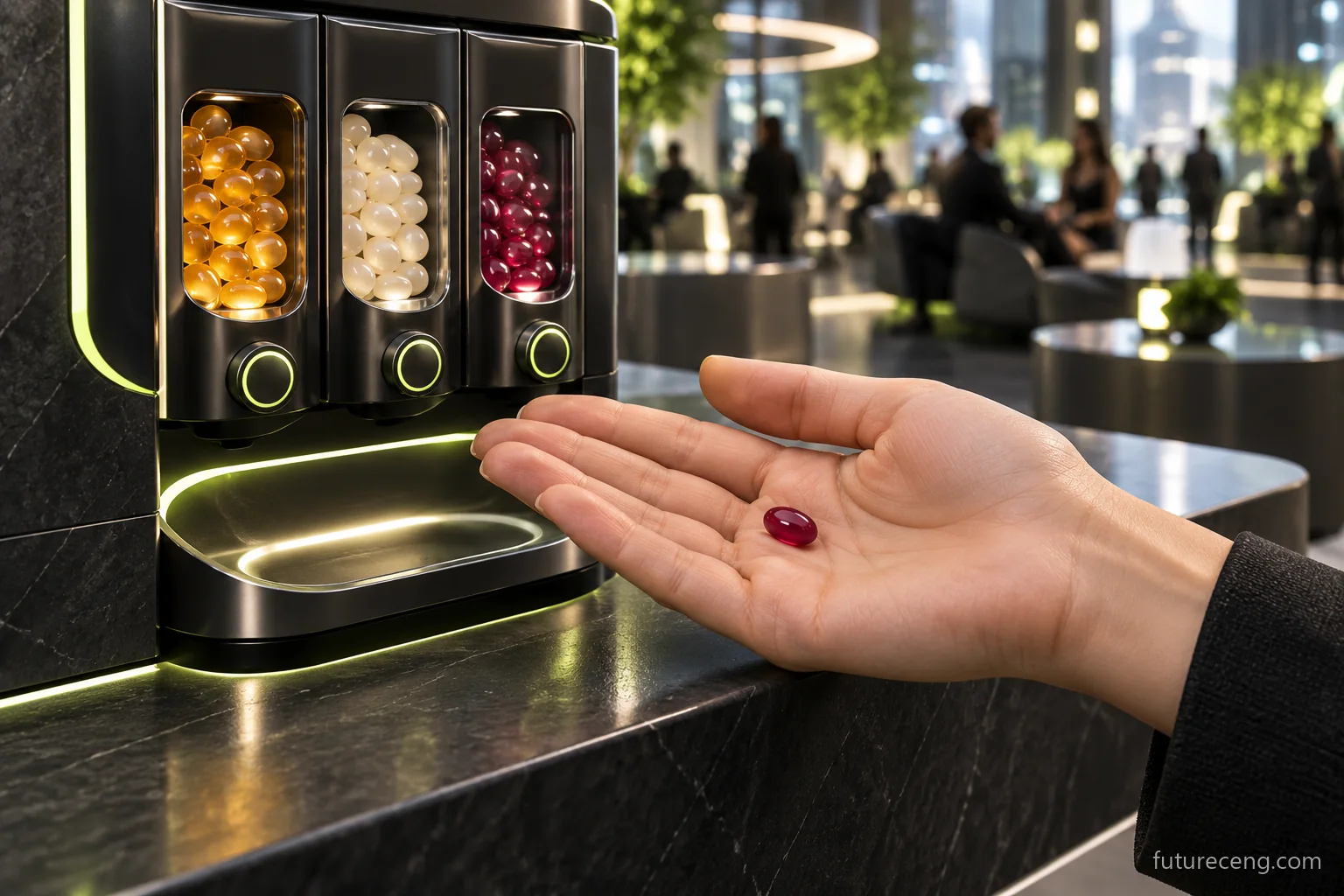
In an interface, the user sees taste options and chooses between them. The result depicted is a capsule small enough to be lost in the palm of your hand, which also explains which taste matches the target of the food.
From a portion to a research question
A team examined a 250-gram sample of meat as a food profile. It makes the answer to the question "What exactly do we want to protect?" visible. This scenario is not a success story where the same content fits into a tiny capsule.
A day of reduced preparation
In the concept, the person carries a small capsule with them and experiences the sweetness of their choice. The goal of replacing daily meals does not turn into a real use proposition unless the nutritional and energy efficiency is verified.
How to change your name / Every Day 3 Gre-eat
Today's experience,
What's tomorrow's business?
What tasks can the experience in this work accomplish with new tools?
The idea of the mini capsule could open up a new field of study exploring the essence of food.
Every Day 3 Gre-eat; a very small, homogeneous nutrient extract capsule with a selectable aroma that can be absorbed or swallowed in the mouth. Food production staff, lab technicians, and distribution teams can take on different research tasks around this idea. While automating repeat sample recordings and inventory reports, it takes human expertise to understand which ingredient is actually measured and what the claims are based on. For example, offering 250 grams of meat in a tiny capsule is a goal, not an accomplished equivalence. Excretion does not eliminate the mass of protein and energy supplies, and the problem of preserving these quantities in small capsules has not been solved by known science. The first area of work is to turn this goal into open-ended questions and measurable research.
It can monitor with experts how different nutrients are identified by editing the source and process records of research samples. The homogeneous capsule records which questions remain open between the target and the available findings. The hygiene, traceability, and consistency skills that come from production expand with research training; the day-to-day job is to establish a reliable data system that experts can compare before producing a ready-to-eat solution.
Within the scope of its authority, it regulates sample identities and evaluation results; it checks with the relevant expert whether the reported content and the data in hand tell the same thing. He considers the claim of feeding on the appearance of a small capsule to be separate. The laboratory expands the record discipline with evidence readability, making it clear in the research file when missing information or an unsupported statement of equivalence is detected.
A future capsule will explore who the product can reach, through what channels, and through what access barriers. It records demands and distribution assumptions from organizations and does not confuse them with proven product capacity. The stock order and field communication experience combine with demand research. The day-to-day work may also be to keep price, information, and distribution issues visible as the technical side of the nutritional goal evolves.
Where's the new business idea? The services that can be investigated may include: editing food composition data, sampling traceability, matching claims with evidence, and examining future access models. The first opportunity is not to sell the unresolved capsule as a finished product, but to understand what the experts are looking for. With scientific advances, design, aroma experience and distribution needs can also be reassessed based on the findings at hand.
- Manually combine repeated content and party recordings
- Collect feed component data from different files
- Rearrange stock and distribution charts
- The food process research technique
- Nutritional Equivalence Data Specialist
- Flavour Experience Designer
- Food Quality and Evidence Coordinator
- Capsule access network is responsible
- Understanding the relationship between food ingredients and quantity
- Quality, traceability and readability of evidence
- User experience and distribution planning
Roles are research and suggestions for the future. The goal of presenting the nutritional essence in small form does not mean that full nutritional equivalence is achieved; it requires expert evaluation and verification.
Read this transition and other projects in AI 4.0EVIDENCE ALONGSIDE THE VISION
Around the world today
how far have we come?
Separating specific ingredients from food, developing concentrated products and different flavors are now separate areas of study. However, extraction does not eliminate the mass of nutrients needed to be preserved. In the FAO's common energy calculation, protein and carbohydrates provide about 4,9 kcal/g of fat. The claim to carry all the protein and energy in a given food in a tiny capsule must meet these physical requirements.
The research goal is to combine concentrated nutrients and a choice of flavours in a tiny capsule. It has not been demonstrated that all the protein, energy and other nutrients in 250 grams of meat can fit into one tiny capsule. Removing water or other components does not automatically provide nutritional equivalence. These concept capsules are not presented as proven complete meals or a recommendation for use.
PRIMARY SOURCES · LAST CHECKED 26 OCTOBER 2026
A BIG VISION. A MEASURABLE FIRST STEP.
What could we
try first?
The first step would be to work with food scientists and nutritionists on a map of nutritional equivalence: what ingredients, what quantities, what mass and volume do the sampled foods require to be preserved? Comparing the calculated limits to the target for the mini-capsule form. Taste experience, absorbability and swallowing are studied as separate design questions; claims of fitness or usability are not published without testing.
A FEW MORE GOOD QUESTIONS
Questions worth asking.
Is there any visible food in the capsule?
The vision is to present the nutrients in a very small form as a homogeneous substance or concentrated content. The capsules in the visuals depict this form; they don't show a formula or content structure that's been realized.
Is it possible to get 250 grams of meat from a single tiny capsule?
This is the target example given by Cenk; it's not an accomplished result. The necessary mass of elements such as protein and energy must be preserved. Filtering or abstraction doesn't diminish all of that in a satisfactory way. It's not shown that the exact equivalent is provided in the mini-capsule.
Can the desired tart be sucked or swallowed?
These are pieces of the targeted experiment. The user should be able to choose the flavor, and different consumption patterns for the small capsule should be investigated. The page describes a concept of the future; it's not a consumption instruction for an existing product.