FC—09EMERGENCY SUPPORT SYSTEMS
Rapid Ambulance
Support beside you while help is on its way.
CONNECTED SUPPORT FOR EMERGENCIES
First support while emergency help is on its way.
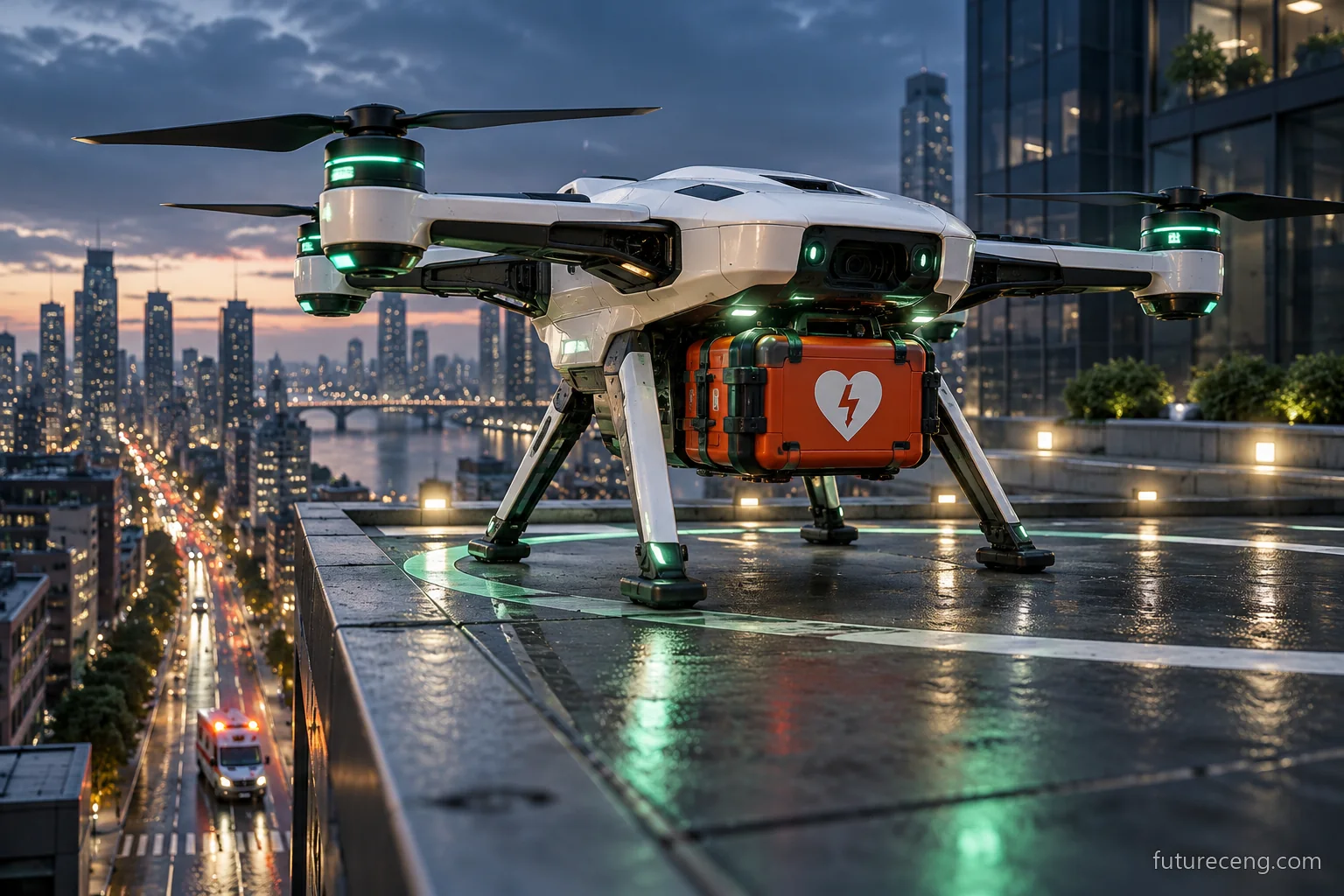
An emergency call begins. As the ambulance team sets off, a drone carrying equipment prepares for a suitable delivery point. The aim is to keep the waiting period connected to professional support.
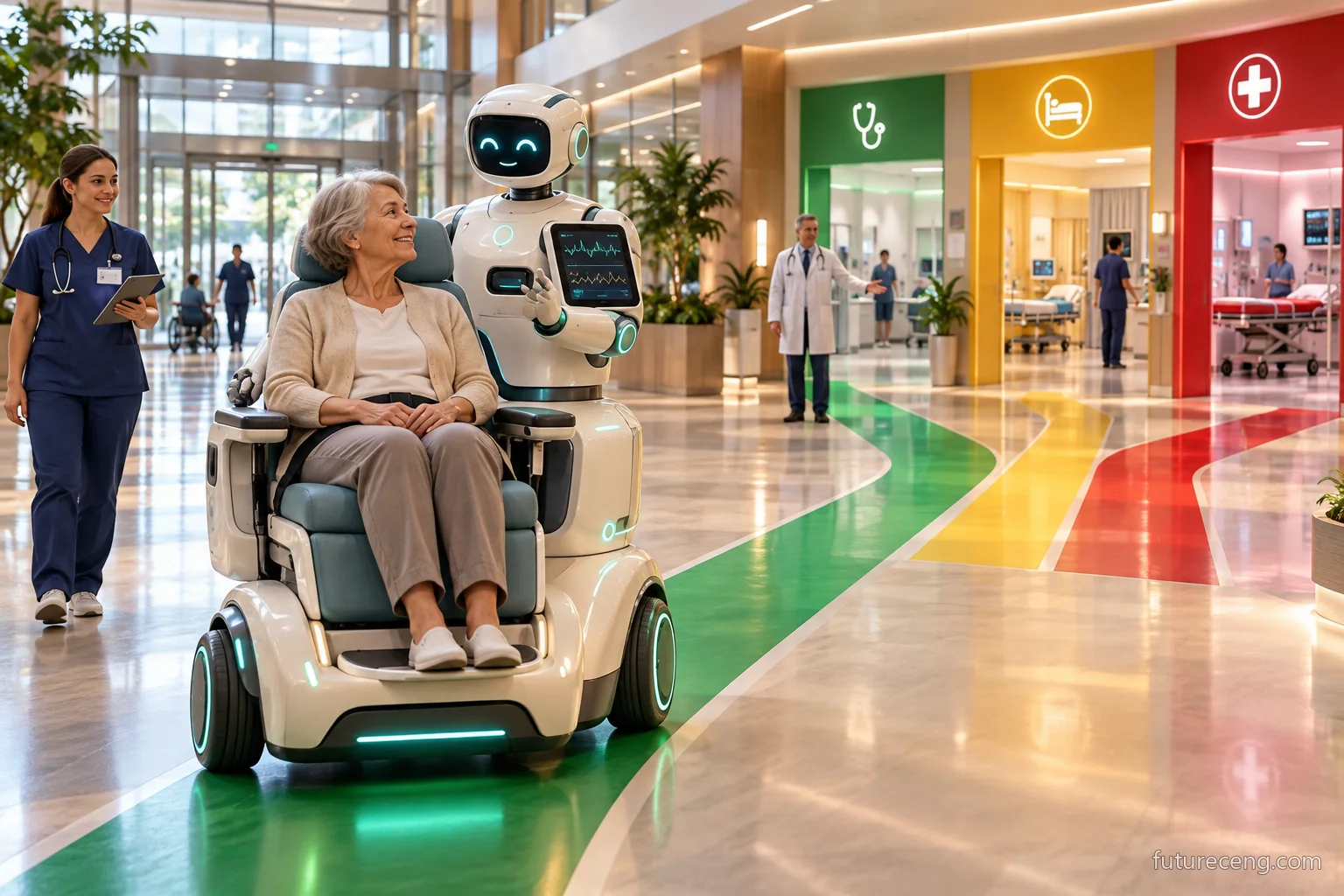
The idea for Rapid Ambulance comes from rethinking what can be done until the emergency medical team gets to the scene. A drone can carry the necessary equipment; a small robot can assist in visual communication with a remote specialist. It's more important that they work in the same operation than the speed of the individual devices. The common mission of this vision is to understand the position correctly, choose the right equipment and provide understandable support to the person in the field.
The person at the scene is usually not a professional intervention team. That's why access to equipment is only part of the story. Planning should also be made on where the package is located, by whom it will be received, and how the authorized center will communicate with the person. Instead of a full-screen instruction, the designed system can provide a connection that the health team can communicate with depending on the situation. Technology can provide an earlier point of contact between the expert and the person in the field.
This is an independent robot, not a doctor's promise. Events like injury, bleeding, or cardiac arrest don't require the same kind of intervention, and assuming a single automated device solves them wouldn't be a good starting point. We want to limit the first goal: to work with an authorized emergency medical organization to deliver equipment and communication in a specific area. Until delivery is complete on such a pilot, it should also be assessed that the medical team is open for round-trip delivery.
Could another route bring initial support while the ambulance is still travelling?
The value of this idea could be more than a tech show racing an ambulance, it could be combining different parts of the same emergency. Calling, location, equipment assignment, and field communication can all come together in a common event identity. So different teams don't have to figure out what's going on over and over. The main product to be explored is the coordination experience and an open periodic process that provides the same continuity as the device in the sky.
THINK OF IT AS A SYSTEM.
Four parts.
One connected experience.
Start with the Authorized Center
The task is assessed in the use scenario defined by the emergency medical operation. Equipment suitability and prioritization depend on the process of the competent team; a personal appraisal alone does not constitute an intervention decision.
Move the equipment to the appropriate location
The operator assesses the mission conditions and the delivery point. Physical access, receipt of the package and communication with the recipient are considered in advance; the proximity of the device to the scene does not mean that the equipment is delivered in a usable manner.
Connect the person in the field
Audio or visual communication can help the authority team communicate with the person at the scene. The interface's job is to make available the current professional communication flow rather than generating independent treatment recommendations.
Hand over to the care team
The incoming team can see what's being sent and what communications are being made. The recording of the mission, retrieval of the equipment and re-deployment are also planned as a continuation of the same operation.
 CONCEPT IMAGE
THINK ABOUT THE FUTURE DIFFERENTLY.The most precious distance in a city is the distance of help.
POSSIBLE EVERYDAY SCENARIOS
Technology matters
when it touches lives.
Let’s look at the intended experience through everyday life.
A large campus
A pilot is attempting to transport equipment in a known area of fixed position. The goal is to identify the issues in the delivery and communication steps before a real emergency occurs. The cycle process is studied in the same exercise.
Find the location of the event
The location indicated on the call, the field signs and the position of the task can be assessed together. Getting information from the user is as important an experience as choosing the fastest vehicle. At each stage, the taskmaster remains open.
When the team arrives
In the planned flow, the health team can see the steps taken before it from the joint record. When the support system is withdrawn, the responsibilities and equipment timing are not left uncertain. The next step is clear among the teams.
How to change your name / Rapid Ambulance
Today's experience,
What's tomorrow's business?
What tasks can the experience in this work accomplish with new tools?
From the delivery desk to the maintenance workshop, new emergency support liaisons.
In the Rapid Ambulance vision, some tasks of call and delivery support personnel, logistics personnel, and biomedical maintenance teams may vary. Re-entering the location of the same event, writing the equipment shipping status to different screens, and transmitting similar updates one at a time can be simplified by automation. In contrast, it is important to communicate openly with the person on the ground, to recognize the lack of information and to communicate the status of the equipment to the competent team. While the ambulance team's clinical responsibilities continue, it may be possible to investigate a more connected conducting of support work around it. The focus of the new roles could be not only on using drones; they could be on ensuring that information doesn't get lost between calling, delivery, communication, and the period.
It shall follow the tasks defined by the authorised team, complete the missing status information from the person concerned and keep the stage of the delivery process visible. The quiet communication and recording precision previously used in phone traffic combines with the ability to interpret task screens. Without making a clinical decision, he can contribute to the team's work on the emergency response with common and up-to-date information.
It tracks the maintenance history and non-use of the equipment it is authorized to use. It accurately records the technical problem reported by the operation team, communicates with the relevant expert, and keeps the preparedness information up to date. The service experience is enhanced by new equipment training; it is also important that records and accountability can be tracked as quickly as possible in daily work.
It tracks the current status and periodic records of equipment required for the designated task. It shall coordinate with the relevant teams to ensure that the equipment used is re-equipped in an appropriate manner. Skills from warehouse layout, inventory tracking and delivery records can be transferred to a new area of support, along with understanding the limits of healthcare operations and being able to talk to different specialists.
Where's the new business idea? These are areas where exercise assessment, equipment traceability, technical support and operational training can be investigated together with healthcare organisations. The first need discovery could focus on showing where the same event information was rewritten today and when it was lost. Even a small coordination solution can produce value to the extent that it makes the existing work of the competent teams more understandable and traceable.
- Manually exporting equipment shipment records
- Re-compile the delivery location information
- Do not send the main status updates of the event
- Emergency support drone operation element
- The health robot care technician
- Emergency equipment logistics coordinator
- Responsible for Remote Health Connection
- A Teacher of Practice and Human Supervision
- Coordination with competent emergency teams
- Equipment and task record tracking
- Open communication and device usage limits
Clinical intervention is the responsibility of a trained emergency medical team.
Read this transition and other projects in AI 4.0EVIDENCE ALONGSIDE THE VISION
Around the world today
how far have we come?
Everdrone is delivering equipment with drones carrying AEDs before an ambulance arrives. Karolinska's fieldwork suggests that in some cases the defibrillator can be used before an ambulance.
With the drone carrying the equipment, different systems of robots interacting independently with all injuries. The person on the scene, the call center and the emergency medical team are part of the operation.
PRIMARY SOURCES · LAST CHECKED 26 OCTOBER 2026
A BIG VISION. A MEASURABLE FIRST STEP.
What could we
try first?
Planning with an authorized emergency medical organization to deliver equipment to a specific campus, locate and try to transmit imagery to a remote team.
A FEW MORE GOOD QUESTIONS
Questions worth asking.
Is Rapid Ambulance going to replace a normal ambulance?
No, I'm not. The purpose of the concept is to explore the possibility of starting equipment and communication support earlier until the competent emergency medical team is reached. Assessing, treating and transporting a patient is part of a professional operation. Drones or small robots can support a specific mission of this operation. Roles should be clearly defined from the beginning.
Will the robot intervene on every injury?
It's not presented as a ready or proven ability. The first scope could be to deliver equipment, make the location visible, and contact the authorized team. Physical robotic interventions for different injuries require separate expertise and research; they should not be reduced to a single automatic flow. Expansion should be evaluated separately in each assignment.
What do you need to learn in the first pilot?
Reaching the correct spot, the availability of equipment by the person in the field, communication, and the health team must be periodically reviewed together. It just doesn't show the value of the product. Controlled exercises can provide a starting point for investigating whether the entire flow is understandable to real users. The findings could lead to a next attempt.