SPACE & LIFE5 MINUTES OF READING
What do we need to know before we go to another planet?
A colony is more than a building. We can begin on Earth by exploring energy, maintenance, communication and life-support cycles with robots.
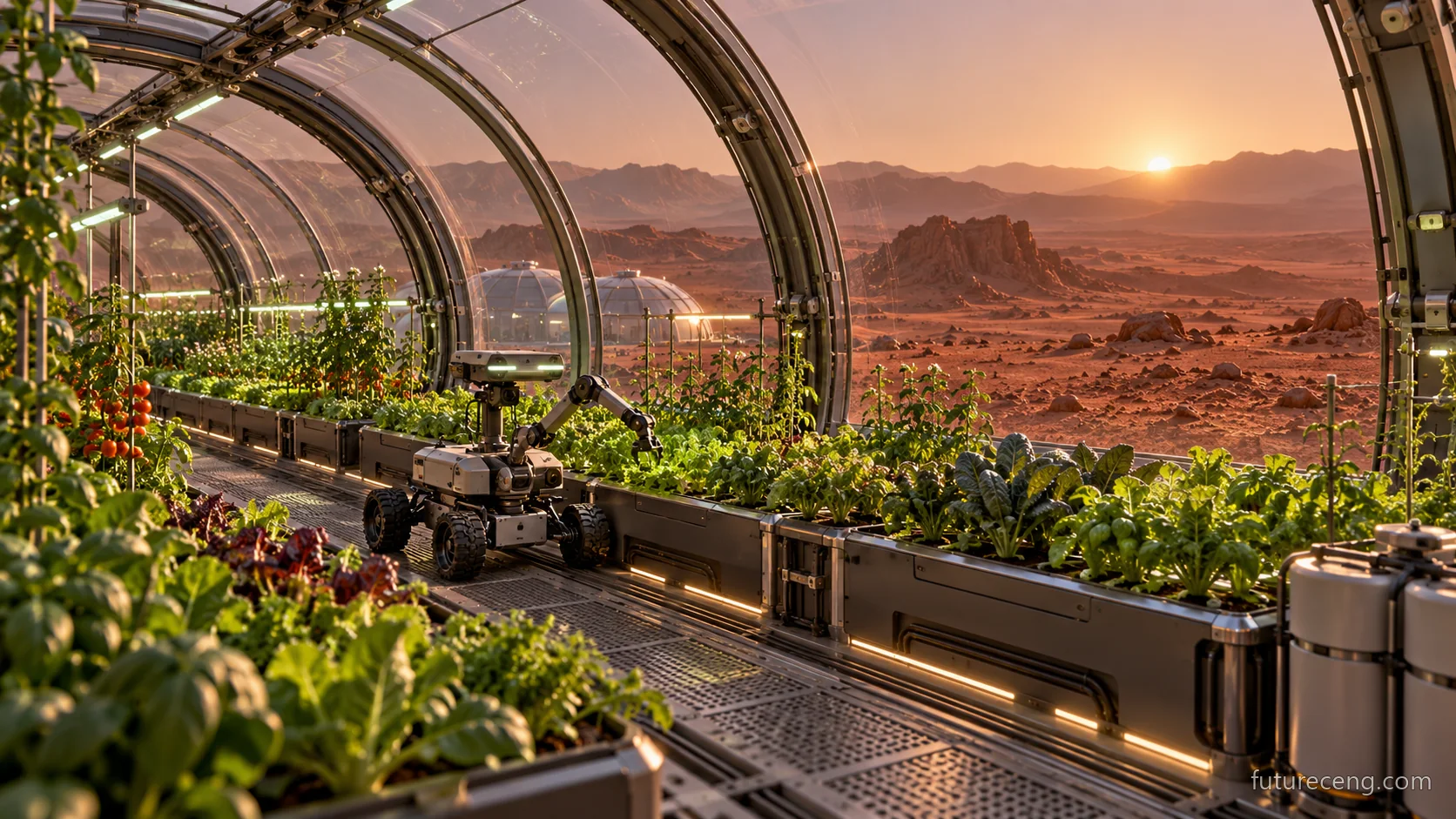
A living space is more than a building.
When imagining the first settlement on another planet, domes, greenhouses, and bright passageways appear. Behind the image, there are relationships that need to work constantly: where does the energy come from, what happens when a piece breaks down, how does the change in the external environment affect the system inside?
The Koloni's curiosity is to investigate these relationships with robots. We're not just thinking about tools that go before people and send photos; we're thinking about small systems that measure the environment, share tasks, and gather information about what conditions a place can be used in. This is a pre-colonial learning program.
First, figure out where we are.
Just because the surface looks smooth from a distance doesn't mean it can move the same way there. The slope the robot encounters, the behavior of the ground, and the access routes can affect the continuity of the mission. First, it is necessary to clearly define what information will contribute to the choice of location.
A more powerful approach might be to move forward with measurements rather than responding to the surface or underground from scratch. Before we draw a magnificent structure, we focus on the information that that structure will need. What the environment says about future design is the same research.
It's the real test of robots working together.
NASA CADRE provides research examples for the autonomous discovery of small robots together; ARMADAS offers research examples to combine modular parts with robots. Some of the sub-questions that concern The Koloni are real engineering fields. These studies are not as mature as human settlements.
In our own hypothesis experiment, let's think about two robots. One's mapping, the other's checking the observation station. When communication is weakened, they need to figure out what to keep and what to stop. Success isn't just about them moving, it's about keeping the mission state clear.
The first greenhouse can be installed here.
Watching the energy and environmental conditions of the little greenhouse on Earth doesn't solve all the problems of life on other planets. But it helps to see how different components interact with each other. The maintenance of the robot, the consistency of the measurements and the behaviour against cuts can be studied together.
Thinking about the difficulty of remote care allows us to look at nearby systems differently. Repairable parts, open missions, and negotiable robots aren't just space issues. The size of the The Koloni is not the size of the first prototype, but it lies in what question we honestly investigate with it.
Further reading
This post is an evaluation of the future and product design. The following resources are for the current studies and research discussed.